
Would you know if disrespect, bullying, favoritism, or inappropriate behavior were becoming normal on one of your teams?
Most harassment prevention training teaches employees what inappropriate conduct looks like, explains company policies, and tests whether employees understand the rules.
That’s important. But it leaves another important question unanswered:
What are your employees actually experiencing at work?
An employee can correctly identify bullying in a training scenario while experiencing that same behavior on their own team. A manager can pass a harassment knowledge check while employees believe people with authority routinely get away with disrespectful behavior.
You won’t uncover those issues by testing knowledge alone.
That’s why Emtrain uses compliance training as an opportunity to listen. Employees watch realistic workplace scenarios and then answer questions about what they see and experience on their own teams.
Instead of only asking, “Did the employee understand the lesson?” you can begin asking, “Is this happening in our workplace?”
Here are six questions organizations can incorporate into training to uncover behaviors and workplace norms that may deserve attention.
What Are the Signs of a Hostile Work Environment?
A difficult coworker, disagreement, or unpleasant interaction does not by itself establish an unlawful hostile work environment.
But organizations shouldn’t wait for workplace behavior to reach a legal threshold before addressing it.
There are warning signs HR, compliance, and people leaders should pay attention to, including:
- Discriminatory harassment: Offensive jokes, racial slurs, stereotypes, or derogatory comments targeting protected characteristics.
- Intimidation and bullying: Persistent verbal abuse, threats, aggressive behavior, or hostile outbursts.
- Abusive supervision: Public shaming, severe favoritism, humiliation, or unreasonable pressure from someone in authority.
- Work sabotage: Unfair tactics or deliberate obstruction that prevents someone from succeeding or growing.
- Intrusive personal interest: Overly personal questions, inappropriate comments, or behavior that crosses professional boundaries.
The challenge is that many of these behaviors happen when HR isn’t in the room.
Your employees are.
So ask them what they’re seeing.
1. Are Employees Hearing Negative Stereotypes?
Ask employees:
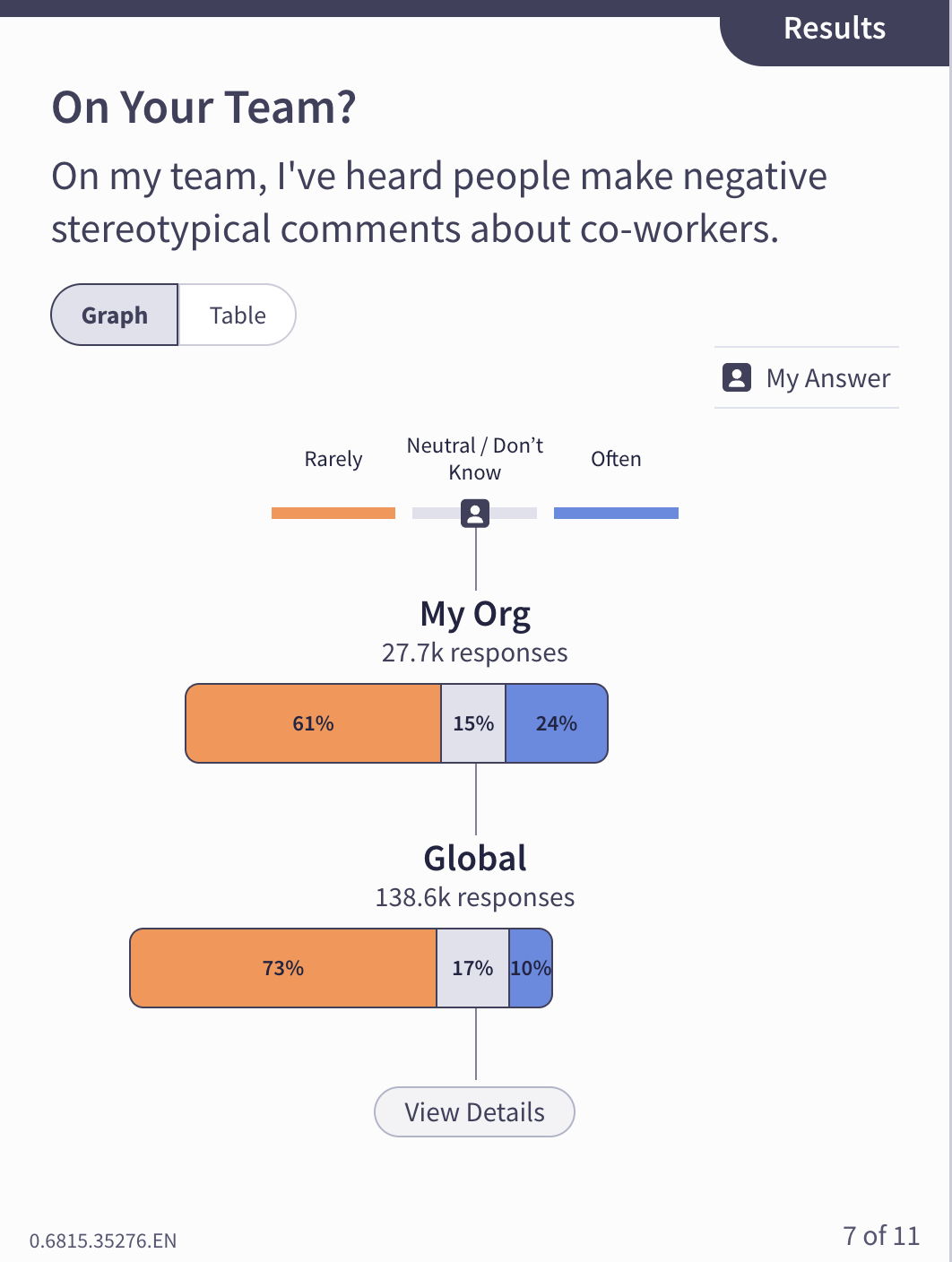
“On my team, I’ve heard people make negative stereotypical comments about co-workers.”
Imagine showing employees a workplace scenario involving stereotypical or derogatory comments and then asking a traditional knowledge question:
Was this behavior inappropriate?
Most employees will probably know the expected answer.
But knowing that stereotypical comments are inappropriate doesn’t tell you whether employees hear them in your workplace.
That’s why Emtrain asks about their experience instead.
Across more than 138,000 global Emtrain responses, 10% indicate employees often hear negative stereotypical comments about co-workers.
The distinction matters.
A knowledge check measures whether employees understand the standard.
An experience question can help reveal whether the organization is living up to it.
If responses suggest stereotypical comments are common on a team, the next step isn’t necessarily another explanation of what harassment means. Employees may already understand that.
Instead, organizations can reinforce the skills needed to recognize stereotypes, interrupt inappropriate behavior, speak up, and establish more respectful workplace norms.
2. Do Employees Feel Their Identity Affects How They’re Treated?
Ask employees:
“My co-workers seem less accepting of me than others because of my personal identity (race, gender, age, etc.).”
Not every concerning workplace dynamic begins with an explicit slur or an obvious act of discrimination.
Sometimes it shows up through who gets included.
Who gets listened to.
Who gets invited into conversations.
Who receives support.
Or simply how people treat coworkers they perceive as different from themselves.
That’s why organizations need to understand more than whether employees recognize discrimination when they see it.
They also need to understand whether employees believe identity affects their own workplace experience.
A pattern in these responses can provide another signal for HR and compliance teams to examine alongside employee complaints, turnover, engagement data, and other workplace information.
It can also point toward a different type of intervention: helping employees recognize in-group and out-group behavior, mitigate bias, and develop the everyday behaviors that make teams more inclusive.
3. Are Employees Observing Bullying?
Ask employees:
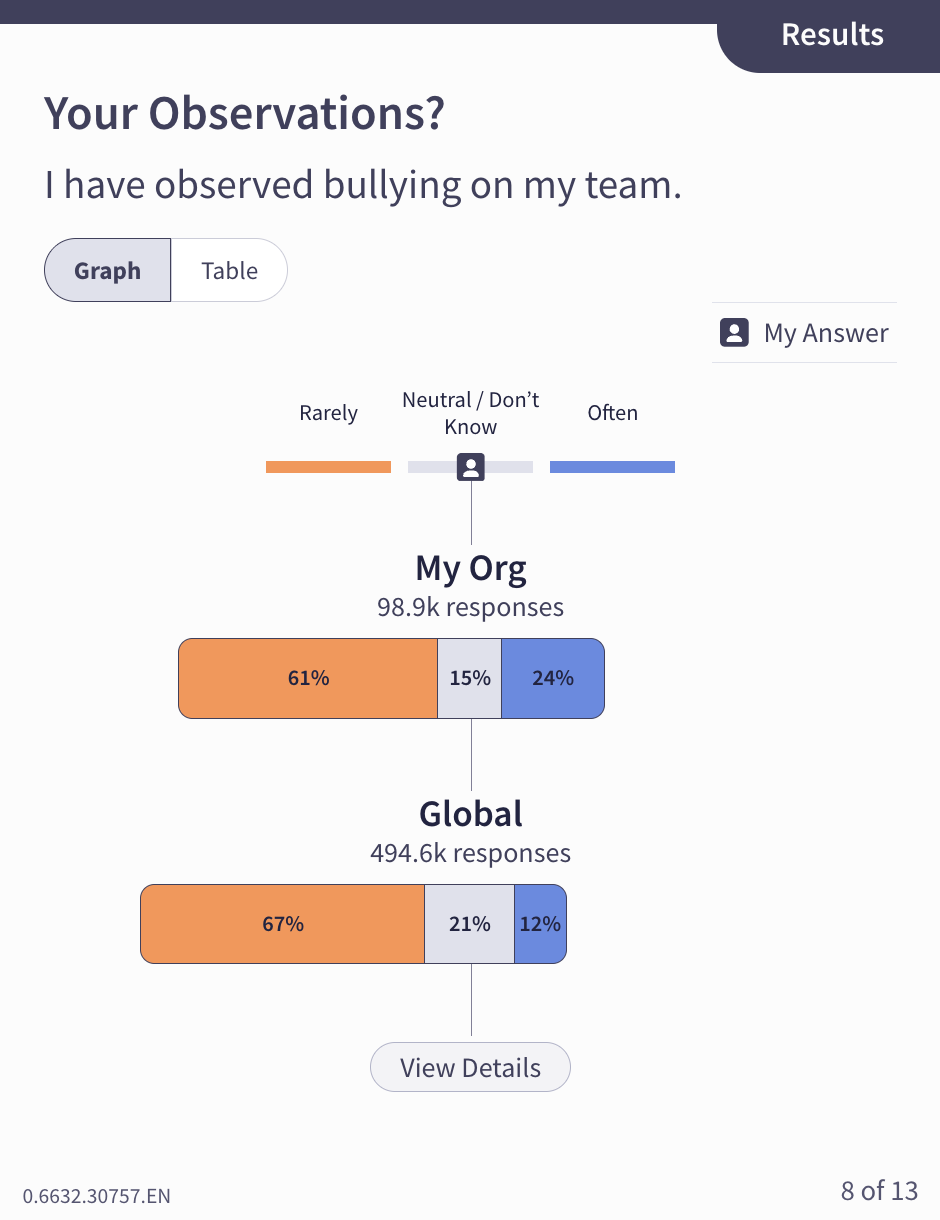
“I have observed bullying on my team.”
Bullying can be difficult for organizations to see from the top.
Employees, however, may see it every day.
They may observe aggressive outbursts in meetings. A coworker may repeatedly become the target of humiliating comments. A manager may use intimidation or unreasonable pressure to get results.
Employees may recognize these behaviors as inappropriate without ever formally reporting them.
That’s what makes asking about the experience so valuable.
Across approximately 494,000 global Emtrain responses, 12% indicate employees often observe bullying on their team.
Consider what those two pieces of training data could tell an organization:
98% of employees completed harassment prevention training.
versus:
12% of employees say they often observe bullying on their team.
Both statements could be true.
But they tell HR and compliance leaders very different things.
The first tells you that training happened.
The second tells you there may still be a problem to address.
When bullying signals emerge, organizations can reinforce skills around de-escalation, responding instead of reacting, respectful communication, bystander intervention, and speaking up.
4. Does Authority Allow People to Get Away With Disrespect?
Ask employees:
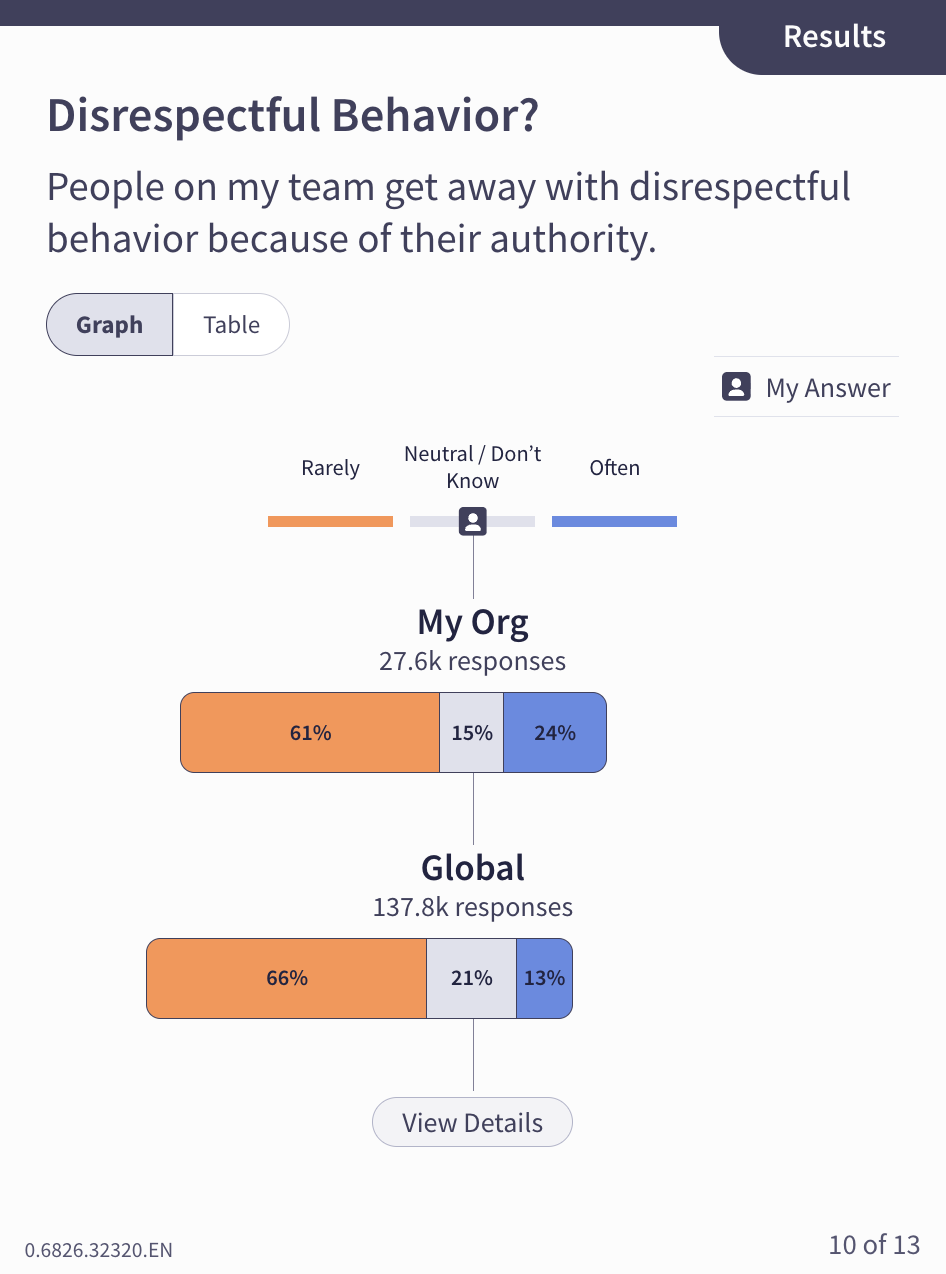
“People on my team get away with disrespectful behavior because of their authority.”
This is one of the most important workplace questions organizations can ask.
A company can have a strong Code of Conduct. Employees can understand its expectations. Managers can complete every required course.
But what happens when someone influential violates those expectations?
Do employees believe the same rules still apply?
Or does authority provide an exception?
Across approximately 137k global Emtrain responses, 13% indicate that people often get away with disrespectful behavior because of their authority.
That’s not necessarily a knowledge problem.
It’s a workplace norm signal.
If employees believe authority determines what behavior is tolerated, simply reminding everyone of the policy may not solve the problem.
Organizations may need to examine manager accountability, power dynamics, consistent enforcement of workplace expectations, and whether employees feel comfortable challenging inappropriate behavior from someone with greater authority.
Training can then reinforce the skills employees and managers need to navigate those power dynamics.
5. Are Managers Modeling Respectful Workplace Behavior?
Ask employees:
“My manager models and reinforces respectful norms of behavior.”
Managers have an outsized influence on what becomes normal inside a team.
Employees notice what managers challenge.
They also notice what managers ignore.
A manager who shuts down disrespectful behavior sends one message. A manager who participates in it—or allows it because a high performer is involved—sends another.
That’s why there’s a meaningful difference between asking:
“Did this manager complete harassment prevention training?”
and:
“Do employees experience this manager as someone who models respectful behavior?”
Abusive supervision can include behaviors such as public shaming, severe favoritism, humiliation, and unreasonable pressure.
If employees consistently indicate that managers aren’t reinforcing respectful norms, the organization has identified a much more specific development opportunity.
Instead of assigning another generic compliance course, HR and L&D can focus on the manager behaviors that need attention: constructive feedback, accountability, communication, emotional regulation, and respectful leadership.
6. Are Managers Maintaining Appropriate Workplace Boundaries?
Ask employees:
“My manager’s informal requests are work appropriate.”
Some warning signs aren’t dramatic.
They’re uncomfortable.
A manager asks overly personal questions.
Someone makes an inappropriate comment about an employee’s appearance.
An informal request begins to cross the line between a professional interaction and unwanted personal attention.
Employees may recognize that something feels wrong without knowing whether the situation is serious enough to report.
That’s another reason training can be an important listening opportunity.
Instead of only teaching employees what unwelcome conduct looks like, organizations can ask whether employees are experiencing behaviors that may indicate professional boundaries aren’t being maintained.
Responses can then help HR identify where additional skill building may be needed around professional boundaries, unwelcome conduct, power dynamics, and reporting concerns.
Don’t Just Ask the Questions. Look for the Pattern.
One employee response doesn’t establish that you have a hostile work environment.
And these questions aren’t intended to replace investigations, reporting channels, employee surveys, or other HR processes.
Their value comes from identifying patterns.
Imagine that responses begin showing:
Employees in one part of the organization report more stereotypical comments.
Another group reports more bullying.
Employees under certain managers are less likely to say their leaders reinforce respectful norms.
And another segment reports that people with authority regularly get away with disrespectful behavior.
Now you aren’t looking at isolated answers.
You’re looking at workplace signals.
Emtrain’s HR & People Risk Monitoring brings together employee responses from harassment and discrimination training to monitor related behaviors across areas such as Mitigating Bias, Connecting In- & Out-Groups, and Managing Power.
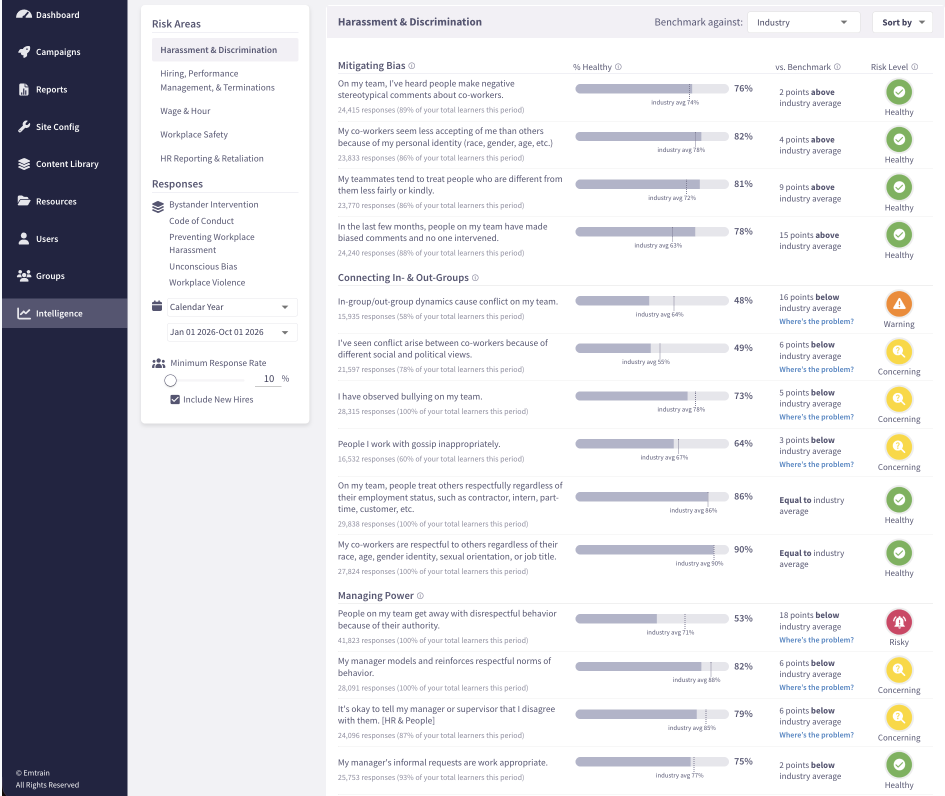
Organizations can compare their results against benchmarks and look for areas where employee experiences deserve closer attention.
That’s when compliance training starts doing something a completion report can’t.
It helps you listen.
Once You Find the Risk, What Do You Do About It?
Finding a concerning result isn’t the end of the process.
It’s where the next stage begins.
If employees report bullying, reinforce de-escalation and intervention skills.
If employees believe authority allows disrespectful behavior, develop managers around power and accountability.
If employees experience identity-based exclusion, reinforce behaviors that help people recognize bias and bridge in-groups and out-groups.
If managers aren’t modeling respectful norms, target the specific leadership behaviors that need development.
And organizations don’t necessarily need to wait until next year’s annual training cycle to respond.
With Emtrain’s AuthorAI, L&D teams can create targeted lessons using their own policies and workplace requirements, incorporate realistic workplace videos, and include questions that help them continue listening to employees.
That creates a continuous process:
Detect → Intervene → Develop → Comply
Detect the workplace signal through employee responses.
Intervene where patterns indicate attention may be needed.
Develop the skills connected to those behaviors.
Comply with training requirements while building a record of how your organization is addressing workplace risk.
Then ask again.
Did the behavior improve?
Did employee sentiment change?
Are the same risks still concentrated in the same areas?
Compliance training no longer has to be the end of the conversation.
It can start one.
Your Employees Know More Than Your Completion Report Does
A completion report tells you who took the training.
A knowledge check tells you whether employees understood the lesson.
Neither necessarily tells you what happens when employees return to their teams.
Are people hearing stereotypical comments?
Are employees observing bullying?
Are managers reinforcing respectful behavior?
Does authority allow certain people to get away with conduct others can’t?
Are professional boundaries being maintained?
Your employees already know the answers to those questions.
The question is whether your compliance training is asking them.
Emtrain combines realistic workplace videos, employee sentiment questions, benchmarking, risk monitoring, and targeted skills development so organizations can move beyond simply documenting training completion.
Because completing harassment prevention training doesn’t necessarily mean the risk is gone.
Sometimes training is where you discover the work that still needs to be done.
Turn Compliance Training Into a Listening Tool
See how Emtrain helps HR, compliance, and L&D teams detect workplace risk, understand employee experiences, and build the skills needed to create healthier workplace norms.