With elections approaching, political conversations are likely to find their way into workplace discussions, team meetings, and after-work gatherings.
Employees may disagree about candidates, policies, social issues, or personal beliefs. And while having different opinions isn’t necessarily a problem, the way employees express those differences can create tension between co-workers.
A political joke might offend someone. A disagreement may turn into gossip. Or an employee might begin avoiding certain colleagues because they no longer feel comfortable around them.
For HR and Compliance leaders, the concern isn’t whether employees agree politically. It’s whether those differences are affecting how people treat one another.
And according to employee sentiment data informing Emtrain’s upcoming 2027 Workplace Culture Report, this is already a challenge for many organizations.
35.5% of responses indicate employees have witnessed conflict between co-workers because of differing social and political views.
That’s more than one in three.
So how can organizations recognize when political disagreements are creating workplace risk, and what can they do to prevent those disagreements from escalating into harassment, discrimination, or a potentially hostile work environment?
When Political Differences Become a Workplace Problem
Talking about politics at work isn’t automatically inappropriate. Employees have different beliefs and perspectives, and respectful disagreement can be part of a healthy workplace.
The problem begins when conversations move away from discussing issues and toward making assumptions about people.
Watch this in action below in this Emtrain workplace training scenario.
Four co-workers are celebrating the end of a long workweek at a bar.
They’re enjoying themselves until someone notices a man nearby wearing an NRA T-shirt.
Several employees begin making jokes about the man’s political views and character. Their comments become increasingly personal, eventually associating gun ownership with violence.
One colleague, Jason, has remained quiet throughout the conversation.
Then he speaks up.
Jason explains that he legally owns a gun and that the comments feel directed at people like him.
His co-workers are surprised. They insist they were only joking and weren’t talking about him.
But from Jason’s perspective, they’ve spent the conversation making negative assumptions about people who share his beliefs.
Suddenly, a group of co-workers who were enjoying an evening together is dealing with an uncomfortable conflict.
And those feelings don’t necessarily disappear when everyone returns to work the next morning.
Could this contribute to a hostile work environment?
Not every offensive political comment creates an unlawful hostile work environment.
However, political and social disagreements can create legal concerns when the conduct involves harassment based on protected characteristics such as race, religion, sex, or national origin.
For example, consider this video on a disagreement about immigration policy may cross a line if employees begin making derogatory comments about a colleague’s national origin.
Similarly, discussions about social issues can become problematic when they turn into repeated insults, workplace stereotypes, or targeted behavior involving protected characteristics.
Whether conduct meets the legal standard for a hostile work environment depends on the circumstances, including the nature, severity, and frequency of the conduct.
But HR leaders shouldn’t wait until behavior reaches that threshold before addressing it.
Disrespectful political conversations can damage working relationships long before they become formal harassment complaints.
How Can HR Detect Political Conflict Before It Escalates?
Most organizations already require employees to complete harassment prevention training.
Employees learn to recognize inappropriate comments, understand protected characteristics, and identify behaviors that could contribute to harassment or discrimination.
But here’s the challenge.
An employee might correctly identify an inappropriate political comment in a training video without telling HR that similar conversations are happening on their own team.
That’s why Emtrain uses Harassment Prevention Training as an opportunity to listen to employees.
Alongside the training content, employees can respond to sentiment questions about their actual workplace experiences.
For example:
“I’ve seen conflict arise between co-workers because of different social and political views.”
This helps organizations understand whether political disagreements are creating tension within teams.
“I am anxious about calling out bias because I don’t want to harm my relationships.”
This explores whether employees feel comfortable challenging inappropriate behavior when they witness it.
These questions provide information that traditional knowledge checks cannot.
Employees may understand what respectful conduct looks like, but that doesn’t necessarily mean they’re experiencing it—or feel comfortable speaking up when someone crosses the line.
Training helps employees recognize inappropriate behavior. Listening helps organizations discover whether it’s happening in their workplace.
Use Emtrain Intelligence to Find Where the Risk Is Developing
Identifying that political conflict exists across an organization is useful. But HR and Compliance leaders need to know where the concerns are developing so they can respond appropriately.
That’s where Emtrain Intelligence comes in.
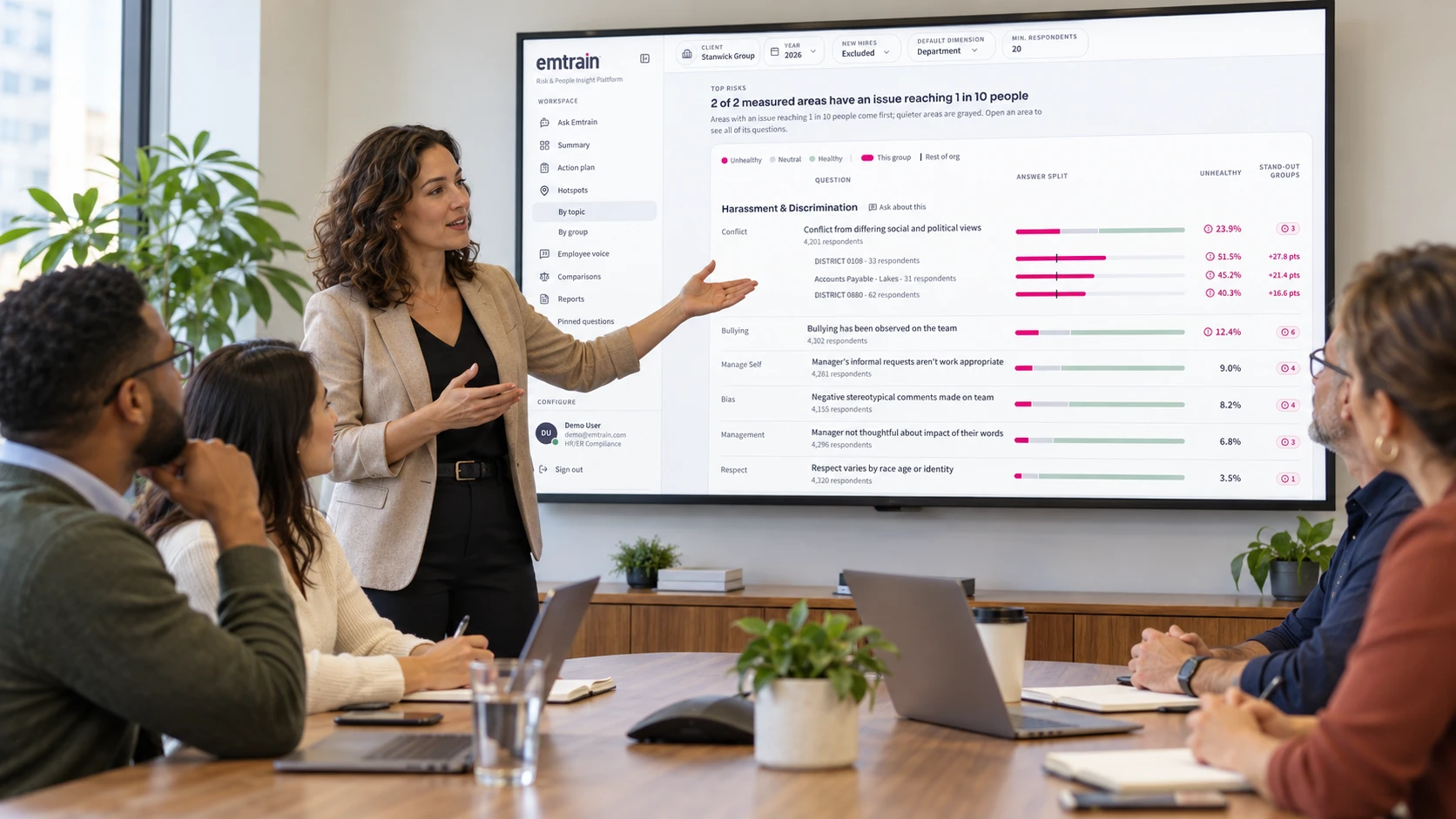
Employee sentiment responses collected during training can be analyzed to identify workplace risk patterns across teams and departments, subject to appropriate privacy protections.
For example, Emtrain Intelligence may reveal that employees in a particular department are reporting more conflict related to social and political differences.
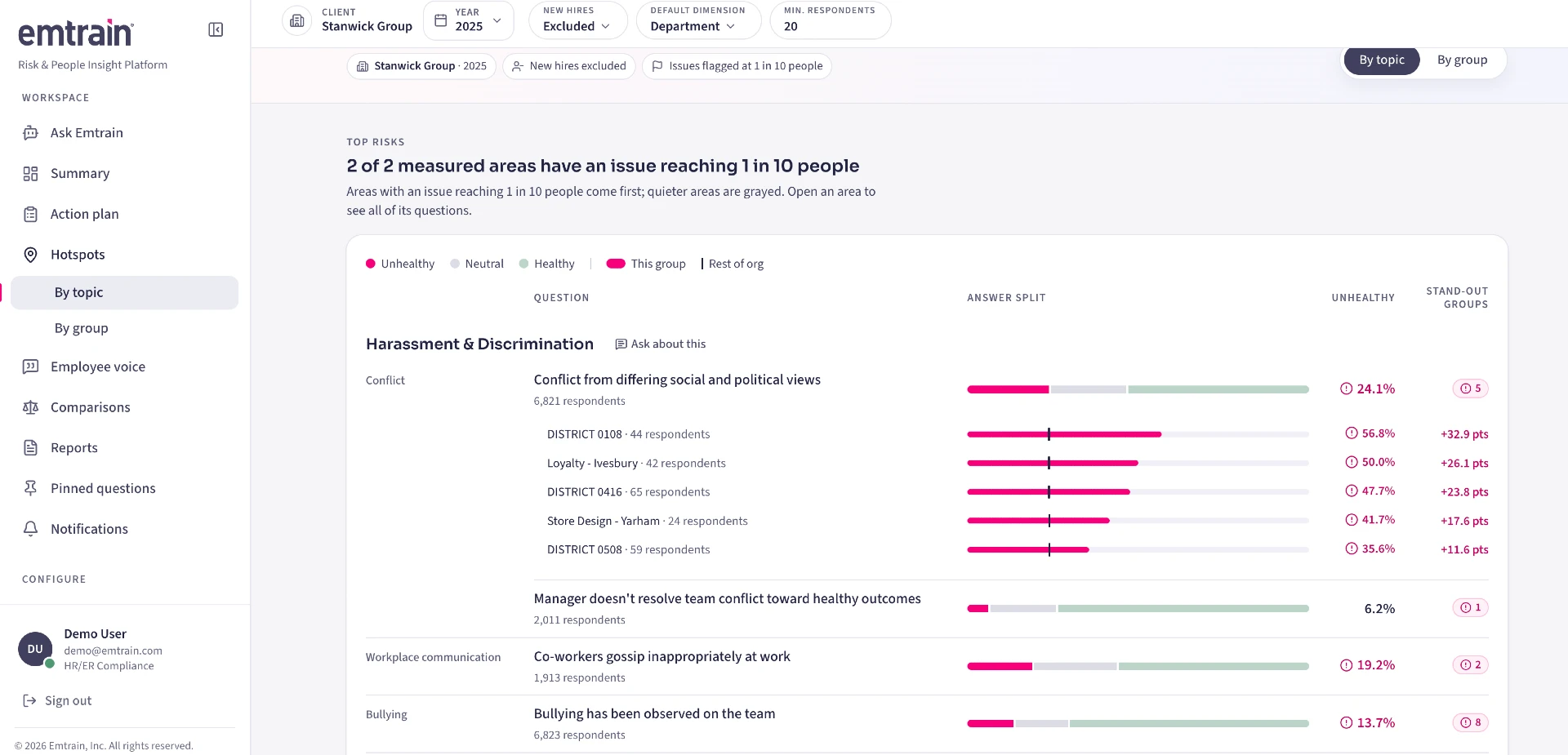
Other sentiment questions may indicate that inappropriate gossip or bullying is also affecting that team.
Together, those signals can help HR understand whether the issue is an isolated disagreement or part of a broader workplace culture concern.
The goal isn’t to monitor employees’ political beliefs or determine which opinions are acceptable.
It’s to identify behaviors that are interfering with respectful working relationships.
With Emtrain Intelligence, HR and Compliance leaders can move beyond knowing that employees completed training to understanding where workplace experiences may require attention.
And once a risk is identified, the next step is helping employees develop the skills to address it.
How to Resolve Political Conflict at Work With Targeted Training
Imagine Emtrain Intelligence identifies a team experiencing elevated conflict over differing social and political views.
Rather than waiting for another annual harassment prevention course, HR can respond with targeted learning designed to address the behaviors contributing to that conflict.
Using Emtrain AuthorAI, organizations can create or adapt learning content and prepare relevant Microlessons for deployment.
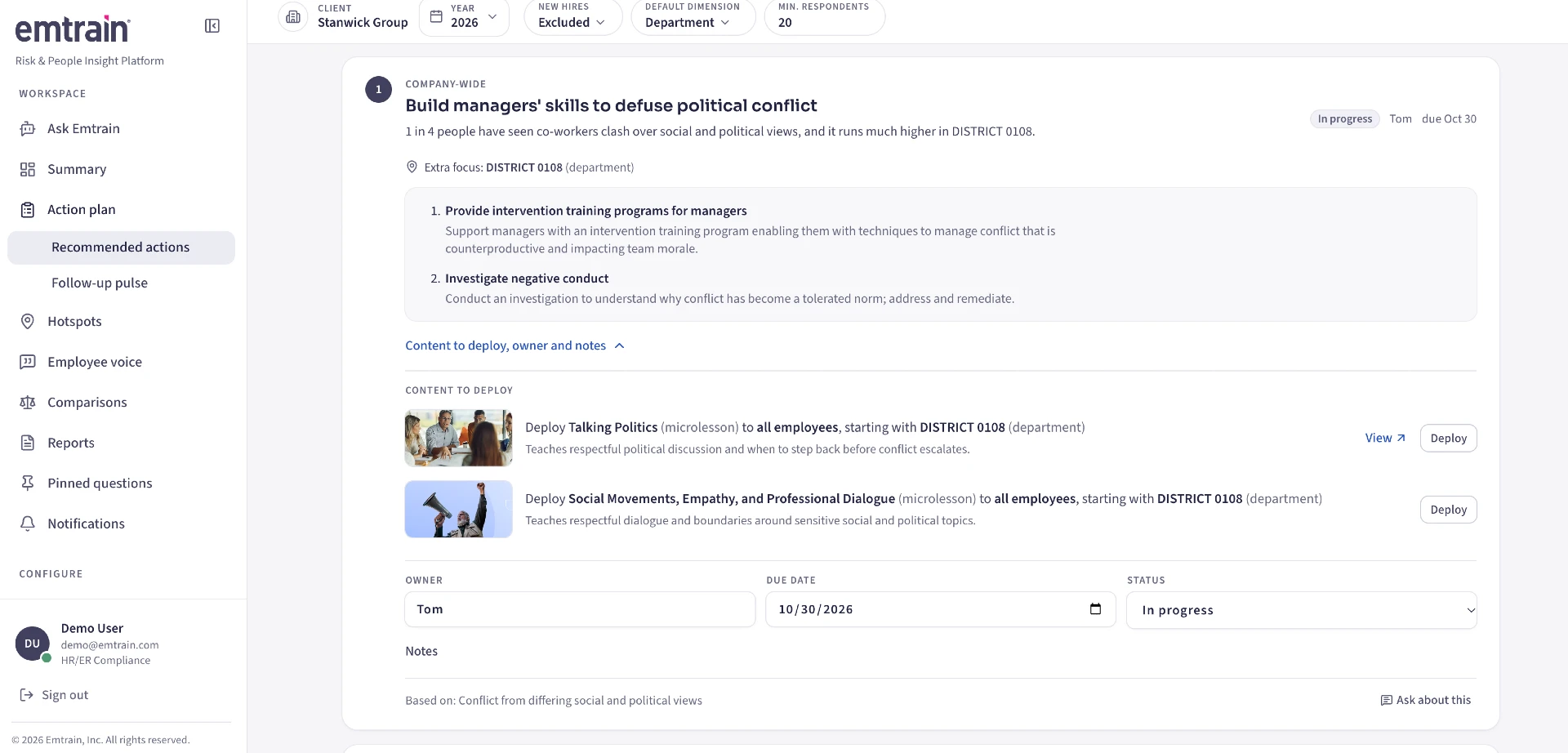

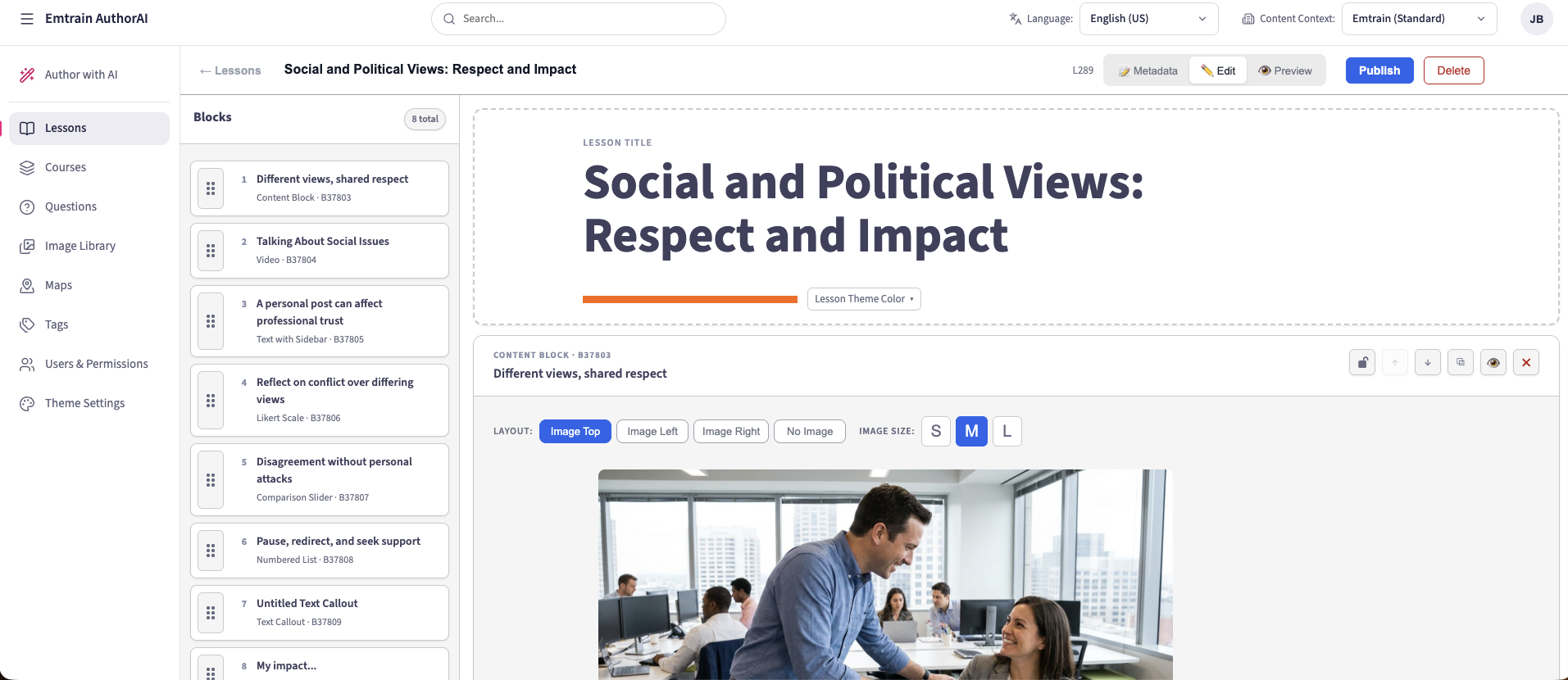
For example, Emtrain’s Talking Politics at Work Microlesson helps employees navigate political discussions without damaging professional relationships.
Other skills may be just as important.
Employees who become frustrated during sensitive conversations can benefit from Managing Our Frustrations.
Teams that struggle to communicate respectfully can practice De-Escalating Conflict With Positive Language.
And employees who hesitate to address inappropriate comments can develop confidence through Encouraging Employees to Speak Up.
These are examples of the practical skills included in Emtrain’s Politics in the Workplace Learning Track.
The objective isn’t to stop employees from having different political opinions.
It’s to help them disagree respectfully, recognize when comments become inappropriate, and prevent personal differences from damaging team relationships.
From identifying risk to changing behavior
This is where Emtrain connects workplace training, employee insights, and targeted skill development.
1. Start with Harassment Prevention Training. Employees learn to recognize inappropriate conduct while answering sentiment questions about their workplace experiences.
2. Identify risks with Emtrain Intelligence. HR and Compliance leaders review employee sentiment patterns to understand where political conflict, gossip, or disrespect may be affecting teams.
3. Respond with AuthorAI and targeted Microlessons. Organizations can develop and deploy learning that reinforces the specific behaviors employees need to improve.
4. Continue listening. Future sentiment responses help organizations evaluate whether concerns persist and whether additional intervention is needed.
Training isn’t a substitute for investigating complaints or addressing misconduct directly. But it can help organizations identify emerging issues and reinforce healthier behaviors before problems become more serious.
Explore Emtrain’s Politics in the Workplace Learning Track
Don’t Wait for Political Disagreements to Become Workplace Complaints
Organizations can’t control the political issues employees care about or expect everyone to share the same views.
But they can establish clear expectations for respectful behavior.
They can help managers recognize when political conversations are affecting team relationships. They can encourage employees to speak up when comments become inappropriate. And they can reinforce the communication skills employees need to work productively across differences.
Most importantly, organizations can listen to employees to understand whether those expectations are being practiced.
Because a completed harassment prevention course doesn’t tell you whether political disagreements are creating tension within a department.
The opportunity is to use training to uncover the risk, employee intelligence to understand where it’s happening, and targeted learning to help resolve it.
How Much Risk Is Political Conflict Creating in Your Workplace?
Political disagreements are only one of the workplace challenges examined in Emtrain’s upcoming 2027 Workplace Culture Report.
Drawing on insights from up to 695,107 employees across more than 385 organizations, the report explores how social and political conflict can signal harassment and discrimination risk, workplace culture benchmarks across four leadership competencies, perspectives from more than 28,000 anonymous employee comments, and five priority actions for HR and Compliance leaders in 2027.
Discover what employees are experiencing and where organizations should focus their attention next.