
The Visibility Gap That Costs Organizations Millions
Senior HR leaders face mounting pressure to demonstrate how people programs impact business outcomes. Yet most organizations rely on engagement surveys that measure employee satisfaction—a lagging indicator that reveals problems months after they’ve taken root. By the time engagement scores drop, valuable employees have already decided to leave, toxic dynamics have calcified, and compliance risks have multiplied.
The C-suite increasingly demands predictive intelligence: which teams face elevated turnover risk, where culture breakdowns threaten compliance violations, and how HR investments correlate with measurable business impact. According to Gartner’s HR research, only 23% of HR leaders feel confident using analytics to predict organizational outcomes. Traditional engagement analytics weren’t designed to answer these questions. That’s where culture risk analytics create strategic differentiation.
What Culture Risk Actually Means and Why It Matters
Culture risk encompasses the organizational dynamics that predict negative business outcomes—turnover, compliance violations, discrimination claims, productivity loss, and reputational damage. Unlike engagement, which measures employee happiness, culture risk identifies specific behavioral patterns and environmental factors that lead to tangible problems. Consider a tech company with strong engagement scores—employees loved the perks, felt passionate about the product, and reported high job satisfaction. Yet they experienced a 40% annual turnover rate among women in engineering and three discrimination lawsuits in 18 months. Their engagement surveys missed what culture risk would have caught: women didn’t feel psychological safety in team meetings, observed inconsistent consequences for inappropriate behavior, and didn’t trust HR to address concerns fairly.
The Business Case for Measuring Culture Risk
Organizations with high culture risk experience quantifiable costs: voluntary turnover rates 2-3x higher than low-risk organizations, compliance investigation frequency 4x higher, and substantially elevated legal liability. A financial services firm discovered that branches in the top quartile for culture risk had voluntary turnover of 31% compared to 12% in low-risk branches, generated 5x more HR complaints and 3x more compliance violations, and—when calculating the full cost of recruitment, training, lost productivity, investigation time, and legal fees—high culture risk was costing $2.4 million annually per 100 employees compared to low-risk environments. More importantly, culture risk is predictive—it identifies problems while intervention is still possible.
How Culture Risk Differs From Engagement Measurement
Engagement surveys ask employees how they feel about their jobs. Culture risk analytics measure whether employees perceive fair treatment, trust leadership, understand behavioral expectations, feel psychological safety, and observe consistent policy enforcement. These factors predict whether employees stay, perform, and behave ethically. Two retail district managers both had 85% engagement scores—their teams felt valued and enjoyed the camaraderie. But culture risk analytics revealed stark differences: in one district, 95% of employees felt they could raise concerns without retaliation and 92% believed discipline was applied fairly. In the other, only 52% felt safe raising concerns and 48% believed discipline was inconsistent. Within 12 months, the second district experienced two sexual harassment claims, a discrimination lawsuit, and the departure of three high-performing employees who cited unfair treatment. The first had zero legal issues and 8% voluntary turnover versus the company average of 22%. The engagement survey captured that both teams were happy. Culture risk analytics predicted which one was headed for costly problems.
The Analytics Framework That Identifies Culture Risk Before Escalation
Sophisticated HR leaders implement multi-layered analytics that capture culture risk indicators across several dimensions:
Behavioral Assessment Data That Reveals Judgment Gaps
When employees complete scenario-based training on harassment, discrimination, or ethical conduct, their response patterns reveal culture risk. Departments where employees consistently justify problematic behaviors or fail to recognize policy violations face elevated risk—even if engagement scores appear healthy. Discover how Emtrain’s behavioral assessments provide early warning signals.
Sentiment Analysis That Identifies Trust Erosion
Beyond simple satisfaction metrics, advanced analytics measure employee confidence in reporting mechanisms, trust in investigation processes, and belief that policies apply consistently. Declining trust scores predict increased legal liability and employee relations issues, providing early warning for HR intervention.
Participation and Completion Patterns That Signal Disengagement
Participation data isn’t just an operational metric—it’s an early warning system. How employees interact with training, policies, and culture initiatives provides visibility into issues long before engagement surveys detect them.
Teams showing declining completion rates, longer time-to-complete patterns, or increased dropout rates often exhibit underlying culture challenges, such as:
- Low psychological safety (employees avoid content that reminds them of unresolved conflict or distrust toward leadership)
- Manager disengagement (leaders who do not reinforce expectations see their teams deprioritize training)
- Fatigue or frustration with organizational processes (slow compliance behaviors predict higher turnover and more employee relations complaints)
- Avoidance of accountability (teams with emerging behavioral issues frequently delay or rush through required learning)
These patterns often precede more visible breakdowns—missed deadlines, rising complaints, or clusters of compliance violations. While engagement surveys might still show “satisfaction,” participation analytics reveal whether employees are actually internalizing expectations or silently opting out.
Culture risk analytics make these signals actionable by flagging the why behind the behavior—whether it stems from leadership gaps, unclear expectations, trust erosion, or inconsistent policy enforcement.
Manager Capability Indicators That Predict Team Outcomes
Culture risk concentrates around individual managers. Analytics that identify managers whose teams show elevated risk indicators—higher turnover, more complaints, lower trust scores—enable targeted leadership development before problems escalate to investigations or legal claims. Research from MIT Sloan Management Review confirms that toxic management represents the strongest predictor of employee attrition.
Comparing Culture Risk Analytics to Traditional Engagement Approaches
Understanding the distinction between these measurement philosophies clarifies their complementary roles:
Engagement Analytics: Understanding Employee Satisfaction
Traditional engagement surveys measure whether employees feel valued, enjoy their work, and intend to stay with the organization. These metrics inform retention strategies, compensation decisions, and general culture initiatives. They’re valuable but retrospective—by the time engagement drops, causative issues have typically existed for months.
Culture Risk Analytics: Predicting Organizational Liability
Culture risk measurement identifies specific vulnerabilities that predict compliance violations, discrimination claims, and legal exposure. Rather than asking “Are employees happy?”, these analytics ask “Do employees understand behavioral expectations, trust that violations will be addressed, and observe consistent policy enforcement?” The answers predict which teams need intervention before visible problems emerge.
Implementing Culture Risk Intelligence: Practical Steps for HR Leaders
Moving from engagement measurement to culture risk analytics requires strategic implementation:
Integrate Culture Risk Measurement
With Existing HR Programs Rather than adding new surveys, embed culture risk questions within training programs, onboarding experiences, and policy acknowledgments. This approach provides continuous data without survey fatigue while connecting measurement directly to learning moments.
Establish Clear Risk Thresholds and Intervention Protocols
Define what constitutes elevated culture risk in your organization—is it trust scores below a certain threshold, completion rates significantly lagging peer departments, or behavioral assessment patterns indicating judgment gaps? Create clear escalation protocols that trigger HR intervention, manager coaching, or executive visibility.
Create Cross-Functional Visibility
Between HR and Legal Culture risk analytics benefit both HR leaders focused on retention and general counsel concerned with compliance liability. Establish governance frameworks that enable appropriate data sharing while maintaining employee confidentiality, ensuring both functions can act on risk indicators.
Build Dashboards That Enable Proactive Intervention
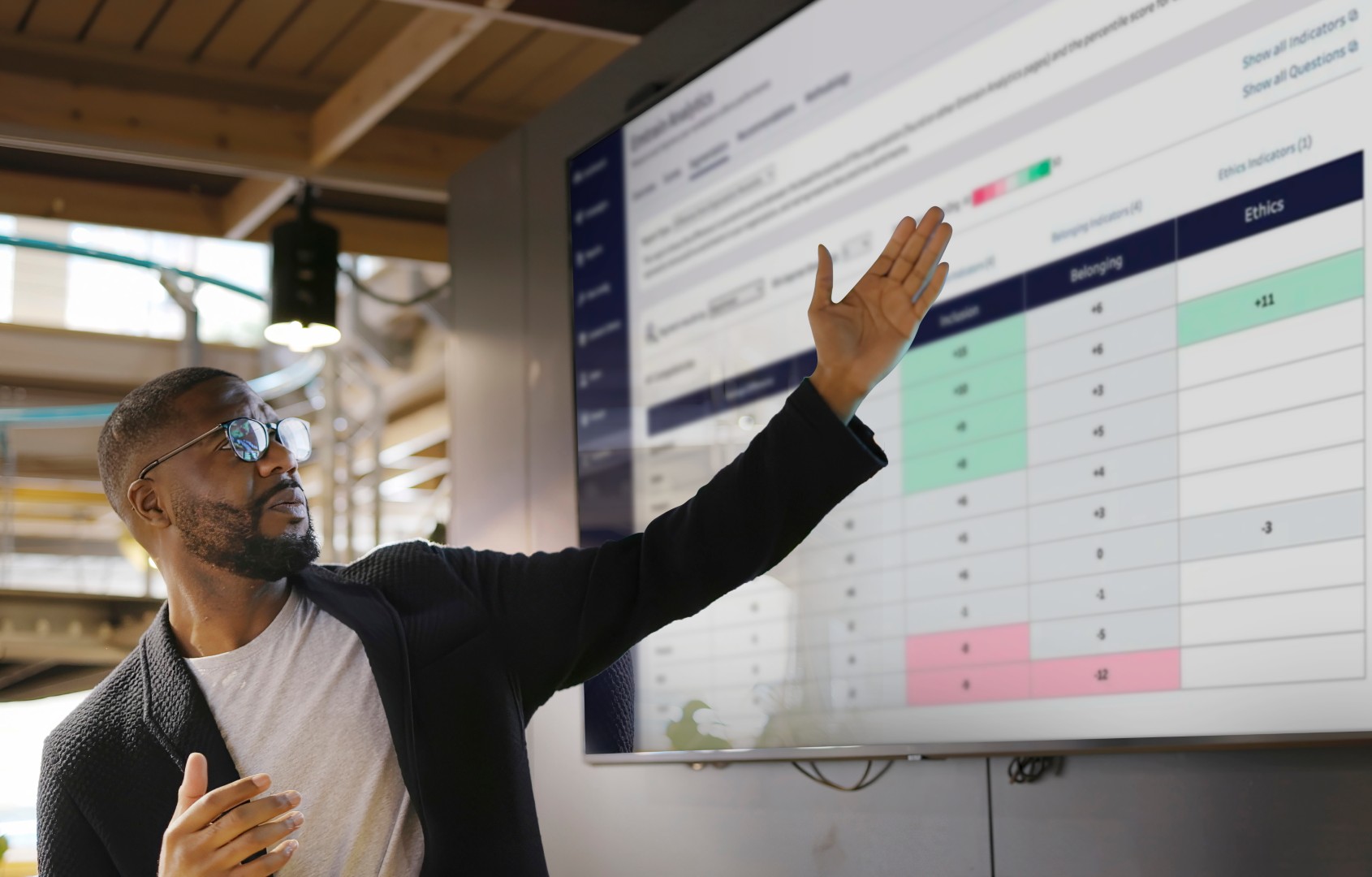
Visibility into culture risk across departments, locations, and manager portfolios enables HR business partners to intervene before problems escalate. These dashboards should highlight trends over time, compare performance across peer groups, and flag statistically significant risk indicators. Learn how to implement HR analytics dashboards that drive decision-making.
Demonstrating ROI: Connecting Culture Risk Analytics to Business Outcomes
Proving the value of analytics investments requires connecting culture risk data to outcomes the C-suite cares about:
Turnover Reduction and Retention Cost Savings
Track whether teams identified as high-risk through analytics experience higher subsequent turnover. Demonstrate cost savings when early interventions reduce attrition in critical roles or high-performing segments. The Work Institute’s Retention Report provides benchmarking data showing average replacement costs exceed $15,000 per employee.
Compliance Incident Prevention
Document whether departments with elevated culture risk scores experience more investigations, compliance violations, or employee relations issues. Show how targeted interventions reduce these incidents over time.
Litigation Risk Mitigation
While culture risk analytics help organizations intervene early, they also strengthen an employer’s position when legal scrutiny occurs. Emtrain’s platform was intentionally designed to support defensible compliance programs—and to stand up in court.
All current clients automatically receive access to Emtrain’s Litigation Report Package, which includes a detailed audit trail capturing every learner’s journey through their training. This record shows:
- Exact modules completed
- Minutes and seconds spent on each card
- Every video watched and interaction completed
- Assessment responses demonstrating recognition of key behaviors
In legal proceedings, this level of admissible evidence is often the difference between a defensible program and one that appears superficial.
Because Emtrain was founded by an employment litigator with deep experience defending harassment and discrimination cases, our methodology is built around real litigation needs. When required, Emtrain also verifies training records and provides expert witness testimony validating your compliance efforts—an invaluable resource in reducing liability and demonstrating organizational due diligence.
Integrating culture risk analytics with this litigation-ready infrastructure allows organizations to not only predict and prevent issues, but to defend their practices with confidence if claims arise..
The Strategic Advantage: From Reactive HR to Predictive People Strategy
Organizations that implement culture risk analytics fundamentally transform how HR functions. Instead of responding to turnover trends, engagement survey results, or compliance incidents after they occur, HR leaders identify and address risks proactively.
This shift positions HR as a strategic partner to the C-suite—providing predictive intelligence that protects organizational value, reduces liability, and optimizes people investments. In an environment where top talent has unprecedented mobility and regulatory scrutiny intensifies, culture risk analytics provide the visibility that separates reactive HR departments from strategic people organizations.
Transform Your HR Analytics Strategy
Talk with our workplace analytics team about implementing culture risk intelligence tailored to your organization’s specific challenges—contact us here.