
Home » Concepts » Diversity, Equity, & Inclusion » Reductions in Force (RIFs)
A Reduction in Force (RIF) occurs when an employer permanently eliminates roles due to economic pressures, restructuring, technological change, or strategic redirection. Unlike performance-based terminations, which focus on individual conduct, a RIF is a business decision that realigns the workforce to new organizational needs. But while the rationale may be operational, the impact is deeply human. A RIF reshapes culture, disrupts trust, and affects both departing and remaining employees. Managing these moments with clarity, empathy, and consistency is essential for maintaining organizational health.
Emtrain’s harassment training course is engaging, interactive, and designed to spot and reduce EEO risk.
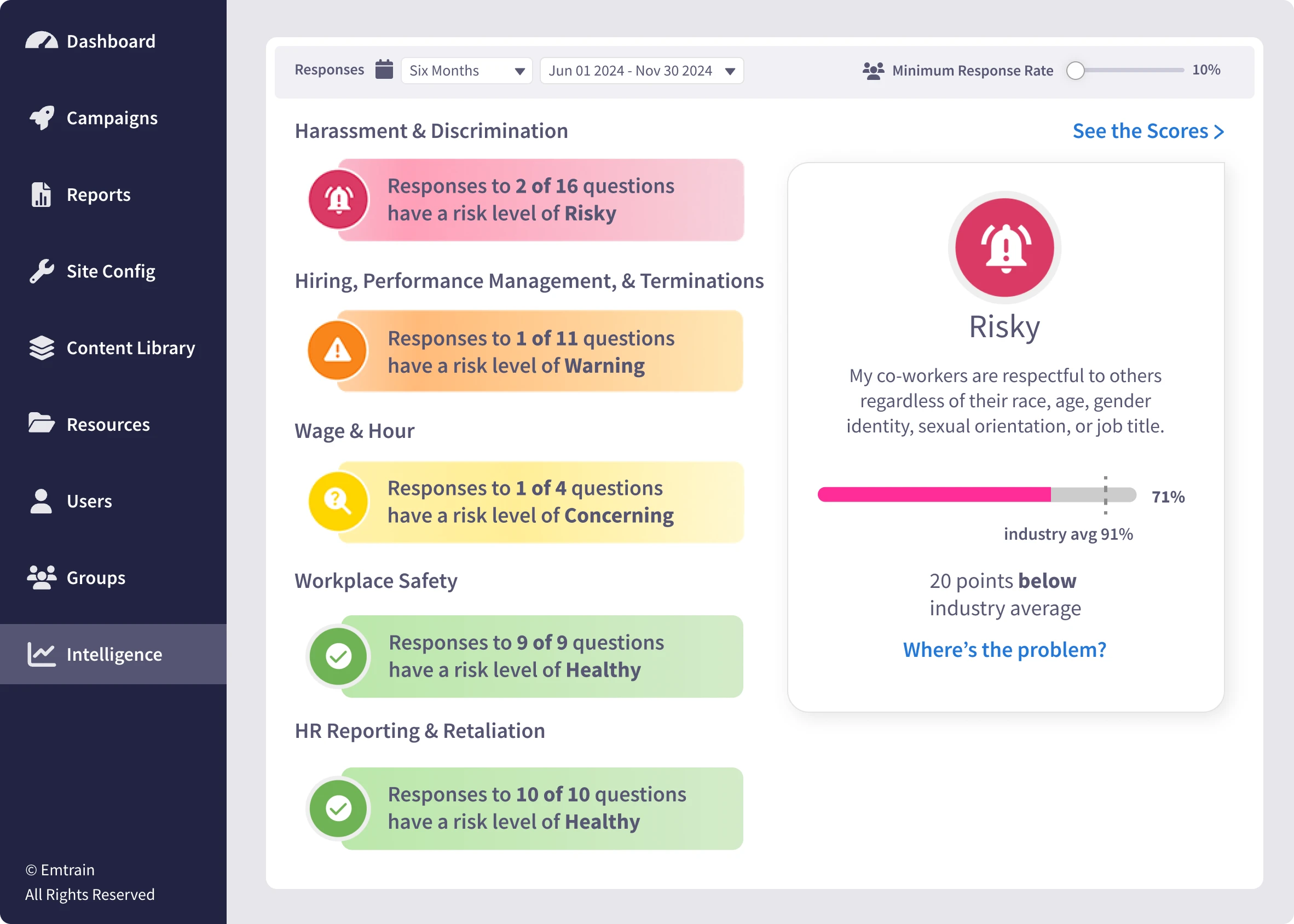
RIFs have long been part of the economic landscape, usually following downturns or major shifts in industry. However, today’s workforce experiences them in more complex ways. With increasing transparency expectations, hybrid work, AI-driven workforce analytics, and heightened public scrutiny, organizations must balance operational necessity with a strong ethical and cultural framework.
From a compliance perspective, poorly executed RIFs can lead to legal exposure under anti-discrimination laws, as highlighted by the U.S. Equal Employment Opportunity Commission (EEOC)
Academic research also shows that layoffs affect not just the separated employee, but the productivity and psychological safety of those who remain. Universities such as UC Berkeley have written extensively about layoff impacts
Recent years have introduced new complexity. Emtrain’s Modern Compliance Guide to Reductions in Force explains how RIFs now require more intentional planning, predictive analysis, and behavioral skills to reduce litigation risk while preserving culture. And as highlighted in AI Is Reshaping Reductions in Force, organizations must consider how algorithmic tools influence workforce decisions—ensuring that any AI-supported assessment does not create disparate impact or bias.
Moreover, Reduction in Force 2025: New Laws and Regulatory Shifts notes that regulatory bodies are increasingly scrutinizing decision criteria, documentation practices, and the transparency of communication. In short, the stakes have never been higher—and the cultural consequences have never been more significant.
Consider a team where several employees have been laid off due to budget cuts. One remaining employee, previously confident, begins experiencing survivor’s guilt and questions whether their job is truly safe. Without proactive communication, that uncertainty turns into disengagement.
In another situation, a manager inherits responsibilities from a disbanded team. They feel pressure to perform without showing strain and unintentionally withdraw from conversations that could support their remaining staff. The team interprets this silence as indifference, creating emotional distance.
Or imagine a workplace where AI-supported analytics indicated “overlapping functions.” Employees may feel a loss of autonomy or fear that decisions were made without understanding their actual responsibilities. The lesson Emtrain reinforces is that RIFs require human dialogue, not just data modeling.
These scenarios mirror the emotional and organizational dynamics explored in the Change Management: Navigating Organizational Transitions microlesson. Employees need psychological safety and clarity—not just new work assignments—to function effectively after a RIF. And managers must understand that even those who stay can feel destabilized.
Organizations that navigate RIFs successfully do more than just follow procedure—they communicate values through behavior. Emtrain’s Guide Reductions in Force Without Losing Your Culture free resource emphasizes that culture continuity should be treated as a core objective, not a secondary concern. This involves planning communication thoughtfully, preparing managers for emotional conversations, and helping teams reestablish purpose after disruption.
Best practices highlighted across Emtrain’s resources include:
Emtrain’s compliance content stresses that a lawful, defensible RIF requires careful planning and thoughtful documentation. But doing it well also requires emotional intelligence, culture skills, and intentional leadership.
Emtrain’s approach integrates both behavioral science and compliance rigor to help organizations address RIFs holistically. Through microlessons like Navigating Organizational Transitions, managers learn practical strategies for leading people through stress, uncertainty, and change.
Our compliance-focused guidance helps organizations develop equitable, defensible RIF processes grounded in objective criteria and consistent documentation. And Emtrain’s thought leadership around AI and RIFs helps organizations navigate technology’s role responsibly, ensuring human oversight prevents unintended bias.
In essence, Emtrain helps organizations protect both their legal position and their cultural integrity. The result is a more resilient workplace—one where employees understand the “why,” feel supported during transition, and remain engaged once the change is complete.
A Reduction in Force is never an easy moment for any organization. It introduces complexity, emotion, and uncertainty for everyone involved. But with thoughtful planning, transparent communication, and a strong commitment to cultural continuity, RIFs can be navigated responsibly. They can even become moments where leaders reaffirm values, rebuild connection, and guide employees toward a renewed sense of purpose.
When organizations prioritize both compliance and humanity, they emerge stronger, more aligned, and better prepared for the future.
Summary: A new manager checks in with an employee who recently lost her entire team in a RIF. She expresses grief, overwhelm, and survivor’s guilt. The manager reassures her that her performance and role remain secure, acknowledges the emotional toll, and collaborates with her to map out a clear work plan for the coming months. The conversation demonstrates how effective leadership during a RIF can rebuild stability, reinforce relationships, and give employees something solid to move forward with.