
A smarter way to compare providers, ensure compliance, and build a healthier culture.
Organizations everywhere are rethinking harassment prevention training. Not because regulations have changed—although they have, and often—but because expectations for workplace behavior, employee experience, and legal defensibility have dramatically evolved in 2025. HR and Compliance leaders are under pressure to select training in 2026 that is accurate, engaging, modern, and capable of driving real behavioral change rather than simply checking a compliance box.
This guide was designed to make that process easier.
Across industries, buyers repeatedly share the same concerns:
How do we know the content is legally accurate? Will employees actually engage with it? Does it address state-specific requirements? How do we measure success?
Your downloadable guide answers these questions with a clear, structured framework for evaluating any training provider—so you can make an informed, defensible, and future-proof decision for your organization.
Why Download This Guide
Whether you’re switching vendors or evaluating harassment training for the first time, this guide equips you with:
- A structured checklist for comparing providers
- The key questions you need to ask during demos
- Clear red flags and evaluation tips
- Guidance on aligning training with organizational goals
- Insights into measuring success beyond completion rates
You’ll walk away with a complete framework to make a defensible, high-impact training decision.
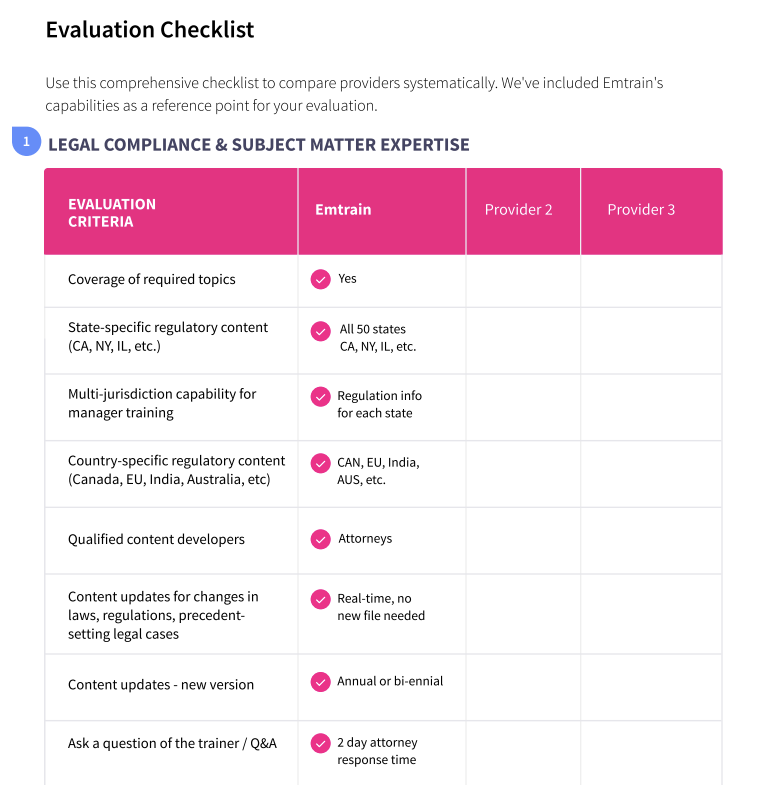
What’s Inside the Guide
Not all harassment prevention training is created equal. Based on Emtrain’s work with thousands of organizations and informed by legal expertise from employment attorneys and HR compliance professionals, this guide breaks down the six essential criteria every organization should use when evaluating online harassment prevention solutions:
- Legal Compliance & Subject Matter Expertise
- Content Quality & Instructional Design
- Engagement & Behavior Change Methodology
- Platform Capabilities & Administrative Efficiency
- Vendor Partnership & Long-Term Support
- Cost Structure & Total Value
Each of these factors contributes directly to the effectiveness of your training program—and to your organization’s ability to meet legal, cultural, and operational expectations. By understanding what truly differentiates a high-quality provider, you reduce your risk, avoid costly mistakes, and choose a partner who will support your team long after the initial rollout.
Why It Matters More Than Ever
Harassment prevention has entered a new era. Laws continue to change at the state and global levels, and the rise of hybrid teams, digital communication, AI tools, and increasingly diverse workplaces has reshaped how employees experience behavior at work.
Your training must:
- Deliver accurate, up-to-date legal content backed by experts
- Address the modern workplace: remote communication, digital conduct, cross-functional teams
- Meet state-specific requirements without forcing HR teams to manage dozens of versions
- Produce measurable culture insights—not just completion rates
- Help leaders and employees build real skills for respectful and psychologically safe workplaces
The downloadable Buyer’s Guide gives you a clear, easy-to-use rubric for evaluating these elements, grounded in compliance best practices and proven instructional design.
1. Legal Compliance & Subject Matter Expertise
Your training provider must demonstrate deep legal expertise and ensure your program meets all harassment requirements at the federal, state, and—if applicable—global levels. This includes:
- Content developed or reviewed by employment attorneys
- Coverage of required topics: sexual harassment, discrimination, retaliation, abusive conduct, gender identity, gender expression
- Compliance with laws for California (AB 1825, SB 396, SB 1343, AB 2053), New York, Illinois, Connecticut, Delaware, and more
- Multi-jurisdiction training capability for distributed or global teams
- Clear documentation and update processes
This section helps you verify legal accuracy and avoid costly compliance gaps.
2. Content Quality & Instructional Design
Training quality directly impacts whether employees learn, retain, and apply new information. The guide outlines what effective instructional design looks like:
- Modern production quality with realistic workplace scenarios
- Interactive exercises, polls, and knowledge checks
- Clear learning objectives with measurable behavioral outcomes
- Practical workplace skills—not just policy summaries
- Content tailored to today’s workplace challenges, including remote/hybrid teams
This section helps you distinguish meaningful, high-impact training from “check-the-box” solutions.
3. Engagement & Behavior Change Methodology
High-quality training goes beyond passive videos. To create real impact, training must incorporate:
- Adult learning principles
- Emotional and cognitive engagement
- Perspective-taking and real-world application
- Behavioral analytics and sentiment insights
- Assessments to reinforce understanding and track retention
The guide shows how to evaluate whether a training provider uses these methods effectively.
4. Platform Capabilities & Administrative Efficiency
The best training fails if the platform frustrates learners or creates administrative burden. Key capabilities to look for include:
- LMS and SCORM compatibility
- Accurate time tracking and audit-ready reporting
- SOC 2 compliance, platform reliability, and data privacy
- Accessibility (WCAG 2.1 AA) and mobile-friendly experiences
- Automated reminders, bulk assignments, and easy user management
This section helps ensure smooth implementation for both learners and administrators.
5. Vendor Partnership & Long-Term Support
Choosing a training provider means choosing a long-term partner. The guide outlines how to assess vendor quality by evaluating:
- Client support response times
- Implementation guidance and rollout support
- Access to dedicated CSMs and advisory resources
- Customization capabilities
- Thought leadership and ongoing content updates
This ensures your partner is reliable, proactive, and aligned with your long-term goals.
6. Cost Structure & Total Value
Pricing varies widely across providers. The guide helps you compare:
- Transparency of per-learner fees
- Customization and update costs
- Completion and satisfaction metrics
- Hidden fees to watch for
- True ROI: culture insights, behavioral analytics, and reduced risk exposure
This section helps organizations avoid unexpected costs and maximize their long-term investment.
Make a Smarter, Safer, More Defensible Training Decision
Choosing the right harassment prevention training isn’t just about meeting regulations—it’s about nurturing a respectful, psychologically safe workplace where employees feel confident speaking up, supporting each other, and practicing inclusion.
The right partner helps you:
- Reduce legal and cultural risk
- Strengthen team communication
- Improve employee perception of workplace norms
- Build long-term organizational trust and resilience
Why Emtrain Harassment Training Is Different
While many providers offer harassment prevention training, Emtrain stands apart by combining legal accuracy, skills-based learning, behavioral analytics, and high-quality storytelling proven to drive real culture change. Unlike checkbox-style solutions that focus solely on compliance, Emtrain’s approach elevates learning into a transformative experience that strengthens workplace relationships, reduces risk, and equips teams with the cultural skills they need to thrive.
Emtrain’s training is built by employment attorneys and instructional designers—not AI-generated scripts or generic stock content. Our program uses realistic workplace scenarios, expert Q&A, adaptive learning, and benchmarking data to give HR and Compliance leaders unparalleled visibility into behavioral trends. The result? Training that is not only compliant, but meaningful, memorable, and measurable.
Top 10 Reasons Emtrain Outperforms Other Harassment Training Providers
Below is a comparison of how Emtrain stacks up against leading competitors EasyLlama, Traliant, and Ethena.
| Reason | Emtrain | EasyLlama | Traliant | Ethena |
|---|---|---|---|---|
| 1. Legal content created by employment attorneys | ✔️ Attorneys review all content | ⚠️ Limited legal depth | ✔️ Some legal oversight | ✔️ Legal-reviewed but less transparent |
| 2. Realistic, cinematic workplace scenarios | ✔️ Professionally produced, multi-camera | ⚠️ Stock-style or templated scenes | ⚠️ Mixed quality reenactments | ✔️ Clean but minimalistic scenes |
| 3. Skills-based learning (beyond compliance basics) | ✔️ 16+ culture and interpersonal skills | ❌ Primarily compliance topics | ❌ Compliance-only | ⚠️ Some behavioral elements |
| 4. Behavioral analytics & sentiment insights | ✔️ Robust analytics included | ❌ Basic completion data | ❌ Limited reporting | ⚠️ Some insights but less actionable |
| 5. Benchmarking against peer organizations | ✔️ Industry benchmarks available | ❌ No benchmarking | ❌ Not available | ⚠️ Limited benchmarking |
| 6. Multi-jurisdiction & global compliance coverage | ✔️ All 50 states + global | ✔️ All 50 states + global | ✔️ Strong US compliance | ⚠️ Limited global |
| 7. Expert Q&A with attorneys (2-day SLA) | ✔️ Available | ❌ Not offered | ❌ Not offered | ❌ Not offered |
| 8. Responsible AI: no AI-generated legal or scenario content | ✔️ Human-created & reviewed | ⚠️ Some generative content | ✔️ Human-developed | ⚠️ AI-assisted content |
| 9. Integration with Workday & enterprise-ready infrastructure | ✔️ Deep Workday integration | ⚠️ Basic LMS compatibility | ✔️ SCORM-ready | ✔️ LMS-friendly but lighter |
| 10. Cultural impact beyond training (frameworks, assessments, tools) | ✔️ CultureTech ecosystem | ❌ Training-only | ❌ Training-only | ⚠️ Limited tools |
Download Your 2026 Harassment Training Guide
Get the full evaluation framework, comparison checklist, and expert insights inside the 2026 Buyer’s Guide to Online Harassment Prevention Training.
Make your next training investment your strongest one yet.