Most retaliation in the workplace is not intentional.
Managers are often trying to resolve conflict, manage performance, or keep projects moving. But when management decisions happen soon after an employee raises a concern, those actions can easily be perceived as retaliation.
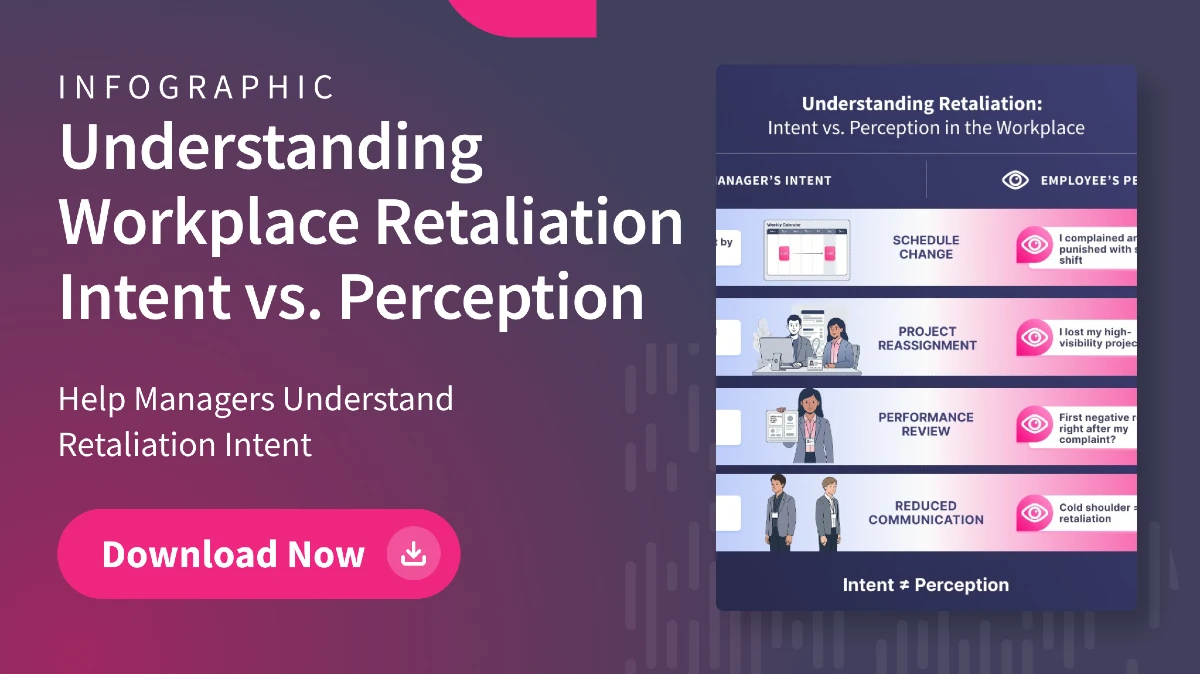
The Intent vs. Perception Retaliation Infographic illustrates how common management decisions may be interpreted very differently by employees after a complaint.
This visual guide part of our Managing Within the Law Training Course, helps managers understand the gap between what they intend and what employees experience.
What This Retaliation Infographic Shows
This quick visual resource highlights how everyday workplace decisions can unintentionally create retaliation risk.
For example:
Manager’s Intent
- “I’ll reduce conflict by separating them.”
- “I’ll avoid awkward interactions.”
- “It’s time to address attitude issues.”
- “I’m protecting myself.”
Employee’s Perception
- “I complained and got punished with a schedule change.”
- “I lost my high-visibility project.”
- “My first negative review came right after my complaint.”
- “My manager is giving me the cold shoulder.”
These examples demonstrate a key leadership insight:
Intent does not equal perception.
Managers must consider how their decisions may appear to employees, investigators, and HR when those decisions follow protected activity.
Why This Matters for Organizations
Retaliation is consistently the most common type of workplace complaint filed with the EEOC.
It is also one of the easiest claims to prove because investigators only need to demonstrate:
- An employee engaged in protected activity
- A negative employment action occurred
- The timing suggests a connection between the two
When managers do not understand how their decisions may appear after a complaint, organizations face increased legal exposure and cultural risk.
What Managers Will Learn in this Retaliation Infographic
This infographic helps leaders quickly recognize:
✔ The difference between management intent and employee perception
✔ How routine workplace actions can appear retaliatory
✔ Why timing matters after a complaint is raised
✔ How subtle behaviors—like reduced communication—can create retaliation risk
✔ Why consulting HR before acting is critical
It serves as a simple visual tool for reinforcing retaliation awareness in leadership training.
Who Should Use This Resource
This infographic is valuable for:
- People managers and supervisors
- HR business partners
- Compliance and legal teams
- Workplace culture and leadership teams
- Organizations strengthening harassment prevention programs
It works well as a training reinforcement tool, a leadership discussion resource, or a quick visual reminder for managers navigating employee complaints.
Download the Intent vs Perception Infographic
Complete the form below to access the Understanding Retaliation: Intent vs Perception in the Workplace infographic and help your managers recognize how everyday actions may create retaliation risk.