When you think of hazardous workplace noise, you might picture a construction site, factory floor, or jackhammer.
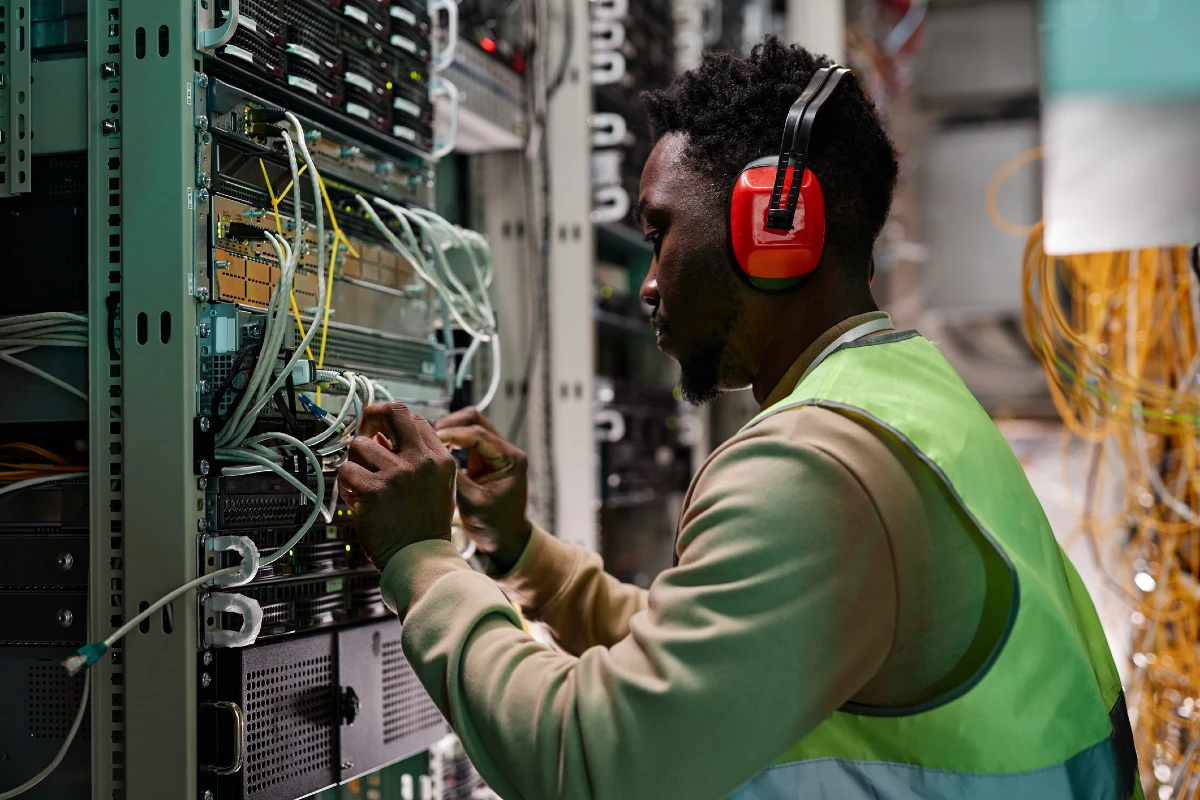
But what about a server room?
Data centers, mechanical rooms, HVAC equipment, generators, industrial printers, power tools, and other common workplace environments can expose employees to significant noise—sometimes without ever feeling dangerously loud.
That’s what makes workplace noise particularly easy to underestimate. Hearing damage can accumulate gradually, and by the time someone notices a change, the damage may already be permanent.
Noise awareness training helps employees recognize these less-obvious risks, understand when workplace noise becomes a concern, and know when they need to protect their hearing.
When Does Workplace Noise Become Dangerous?
Sound is measured in decibels (dB), and both the volume of the noise and the amount of time you’re exposed to it matter.
Normal conversation is around 60 dB. As noise levels increase, the amount of time someone can be exposed without increasing the risk of hearing damage decreases.
In other words:
The louder the noise, the less time it takes for it to potentially damage your hearing.
OSHA uses an 8-hour time-weighted average of 85 dBA as an important threshold. When employee exposure meets or exceeds that level, employers covered by OSHA’s general industry standard must implement a hearing conservation program.
But employees shouldn’t assume noise is safe simply because it doesn’t hurt.
One of the most important lessons of workplace noise awareness is that noise can affect your hearing before it feels dangerously loud.
Workplace Noise Isn’t Just a Construction or Manufacturing Problem
Construction and manufacturing environments have obvious sources of excessive noise: power tools, heavy equipment, grinders, compressors, generators, and machinery.
But workplace noise exposure can occur in places employees might not immediately associate with hearing hazards.
Server Rooms and Data Centers
Server rooms are a good example.
Cooling systems, fans, servers, and other equipment can create constant background noise. Because that noise is continuous rather than sudden—and employees may still be able to hold a conversation—it can be easy to dismiss.
Employees performing maintenance, troubleshooting, installation, or other work may spend extended periods in these environments.
Larger data centers can be even louder as hundreds or thousands of pieces of equipment operate simultaneously.
The lesson isn’t that every server room is hazardous. It’s that employees shouldn’t judge noise exposure solely by how loud an environment feels.
Equipment and Mechanical Areas
Employees may also encounter significant noise around:
- HVAC and ventilation systems
- Generators
- Compressors
- Forklifts
- Industrial printers
- Power tools
- Manufacturing equipment
- Mechanical rooms
Even employees who don’t regularly work in high-noise jobs may occasionally enter these environments.
That’s why noise awareness isn’t only relevant to employees who spend their entire workday on a factory floor.
The Hidden Risk of Cumulative Noise Exposure
Workplace noise isn’t always one extremely loud event.
Exposure can accumulate.
An employee might spend part of the day in a server room, another portion around noisy equipment, and additional time in a mechanical area.
No single experience may seem especially concerning. But repeated or prolonged exposure can become more significant over time.
This is one reason noise-induced hearing loss can be difficult to recognize early. Employees may not notice a dramatic change from one day to the next.
Instead, hearing damage can develop gradually.
How Can You Tell If Your Workplace Is Too Loud?
Employees shouldn’t try to determine safe exposure levels themselves—that requires proper evaluation and measurement.
However, there are warning signs that workplace noise deserves attention.
For example, you may be experiencing excessive noise if:
- You frequently need to raise your voice to communicate with someone nearby.
- Your ears ring or buzz after leaving a work area.
- Sounds seem muffled after your shift.
- You temporarily have difficulty hearing after noise exposure.
- You experience pressure or discomfort in your ears.
- You notice hearing changes after spending time in certain work areas.
These signs don’t replace professional noise measurements or hearing evaluations, but they shouldn’t be ignored.
Employees should report concerns about excessive workplace noise according to their organization’s safety procedures.
Why “I Can Still Hear Fine” Can Be Dangerous
Noise exposure creates an unusual workplace safety challenge because the consequences aren’t always immediate.
An employee might think:
I’ve worked around this equipment for years.
Or:
It doesn’t sound that loud.
Or simply:
I can still hear fine.
But hearing ability isn’t a reliable measurement of whether current noise exposure is safe.
Noise-induced hearing loss can develop gradually, and once hearing has been permanently damaged, it may not be restored.
Hearing protection is about protecting the hearing you have today—not waiting until you notice that something has changed.
How Can Employees Protect Their Hearing?
Reducing workplace noise exposure can involve a combination of workplace controls, safe work practices, and personal protective equipment.
Depending on the environment, hearing protection may include:
Earplugs that fit inside the ear canal and reduce the amount of sound reaching the inner ear.
Earmuffs that create a protective seal around the ears.
Dual protection using both earplugs and earmuffs in certain high-noise environments.
But simply providing hearing protection isn’t enough.
Employees need to understand when protection is necessary, which type is appropriate, and how to wear it correctly. Improperly fitted hearing protection may not provide the intended level of protection.
That’s where effective noise awareness and hearing protection training becomes particularly important.
What Else Can Reduce Workplace Noise Exposure?
Personal protective equipment is only one part of protecting employees from excessive noise.
Depending on the workplace and hazard, other strategies can include:
- Reducing unnecessary time around loud equipment
- Increasing distance from noise sources
- Using barriers or equipment enclosures
- Maintaining equipment to reduce excessive noise
- Taking appropriate breaks away from noisy areas
- Identifying and reporting unusually loud equipment
- Participating in workplace hearing conservation programs
- Completing hearing tests when required or provided
Employees should also never assume an environment is safe simply because other people aren’t wearing hearing protection.
Follow your organization’s safety requirements and raise concerns when something doesn’t seem right.
Workplace Noise Is Also a Compliance Risk
Protecting employees from excessive workplace noise isn’t simply a safety best practice. For employers covered by OSHA’s occupational noise standards, certain levels of employee noise exposure can trigger specific legal obligations.
Under OSHA’s general industry standard, an 8-hour time-weighted average exposure of 85 dBA is the action level that triggers a hearing conservation program. That program can require employers to monitor noise exposure, provide audiometric testing, make appropriate hearing protection available at no cost, provide employee training, and evaluate whether hearing protection provides adequate protection.
OSHA also sets a permissible exposure limit of 90 dBA over an 8-hour workday for general industry. When exposures exceed permissible levels, employers may have additional obligations to use feasible engineering or administrative controls and, when necessary, personal protective equipment.
Failure to properly identify and address workplace noise can therefore create risks beyond hearing damage. Employers may face OSHA citations when required hearing conservation measures aren’t implemented or required hearing protection isn’t used. OSHA’s enforcement guidance indicates that some hearing-protection violations involving overexposure can be classified as serious.
This is why employers shouldn’t wait for employees to report hearing problems before evaluating workplace noise. Prevention, monitoring, appropriate controls, hearing protection, and employee training all play a role in reducing both employee health risks and organizational compliance risk.
Why Noise Awareness Training Matters
Noise awareness training helps turn something employees might otherwise ignore into a recognizable workplace safety issue.
Employees should be able to recognize that workplace noise isn’t limited to obviously loud jobs. They should understand that exposure can accumulate over time and that protecting their hearing needs to happen before they notice hearing loss.
Effective training can help employees recognize:
- Where workplace noise hazards may exist
- Why exposure time matters
- Early warning signs of excessive noise exposure
- When hearing protection may be necessary
- Why properly fitting PPE matters
- When to report a workplace noise concern
The goal isn’t to turn every employee into an occupational noise expert.
It’s to help employees recognize when noise deserves their attention.
Protect Your Hearing Before You Notice a Problem
Hearing affects far more than someone’s ability to perform a job.
It affects conversations with family and friends, music, social interactions, awareness of the surrounding environment, and overall quality of life.
And unlike many workplace injuries, noise-induced hearing loss can happen so gradually that employees don’t realize what they’re losing.
That’s why protecting hearing today matters.
Teach Employees to Recognize Workplace Noise Hazards
Emtrain’s Noise Awareness Training microlesson helps employees recognize potentially hazardous noise environments, understand cumulative exposure, identify warning signs, and learn how to properly protect their hearing.
Rather than focusing only on traditional high-noise workplaces, the lesson also addresses less-obvious environments employees may encounter, including server rooms, data centers, mechanical areas, equipment operations, and other everyday workplace noise sources.