
When Work-Life Boundaries Become Battlegrounds
Generational conflict often reaches a boiling point around work-life balance expectations. Younger employees increasingly prioritize flexibility, mental health, and work-life integration. Many older employees, shaped by different career norms, may equate long hours and physical presence with commitment and professionalism. These divergent values create friction that managers must navigate carefully to avoid escalating into harassment claims or retention crises.
Consider a scenario where a manager expects an employee to work late to meet a critical deadline, but the employee has a standing rehearsal commitment. The employee insists on leaving: “I have a work/life balance and I’m not going to feel badly about that. Just because YOU always work after hours doesn’t mean I have to.” The manager responds that the employee’s actions affect the team and calls the behavior “rude.” Watch the workplace scenario below:
Who’s right? Both see the situation through their generational lens, and without intervention, this conflict can poison team dynamics and create compliance risks.
Understanding Generational Differences in Work Attitudes
The Shifting Definition of Professional Commitment
Research shows that attitudes toward work-life boundaries have evolved dramatically across generations:
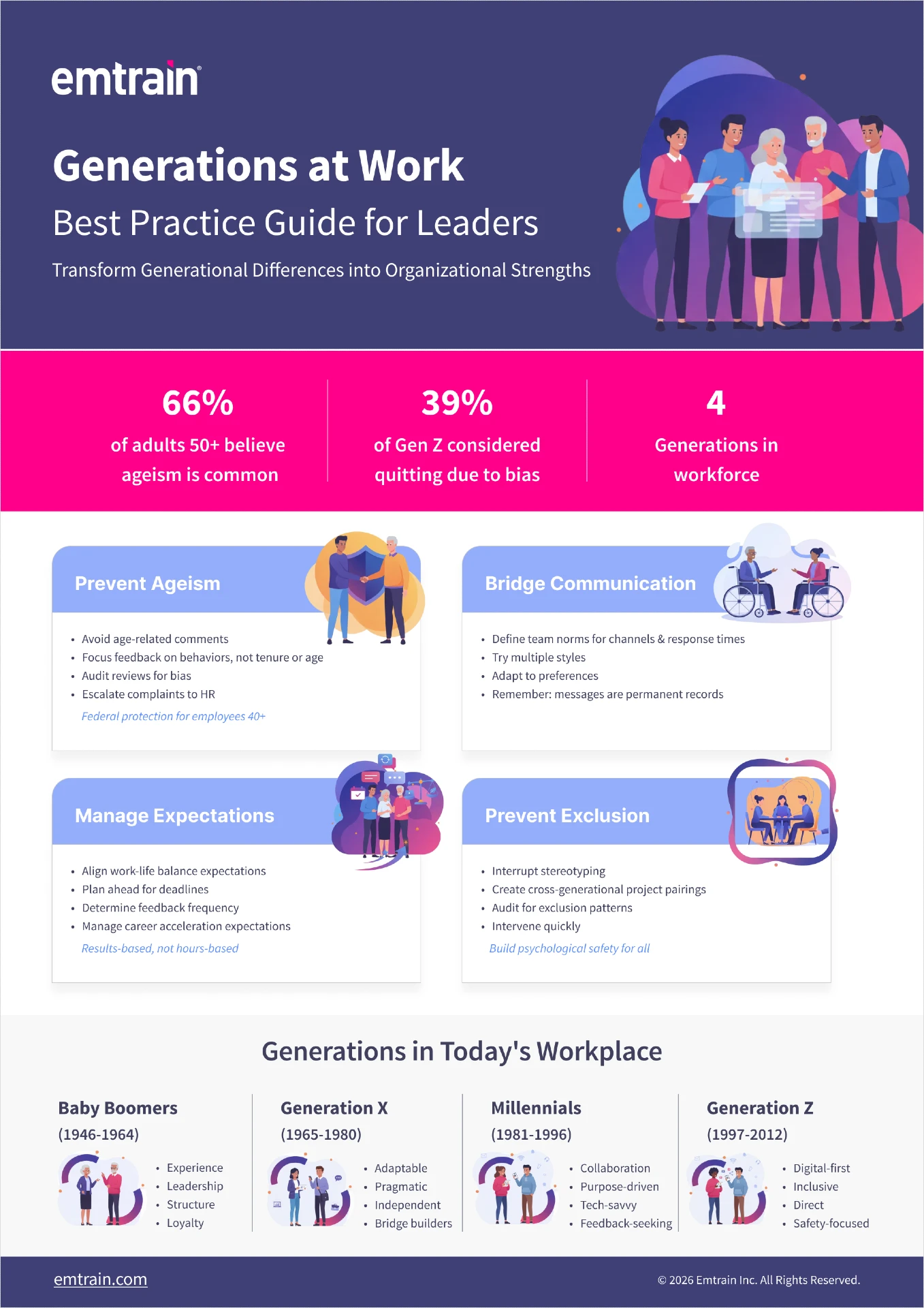
Baby Boomers (born 1946–1964) are often characterized as work-centric and competitive, viewing long hours as signs of dedication and loyalty. They value job security and traditional career advancement, shaped by post-WWII economic expansion.
Generation X (born 1965–1980) pioneered the “work hard, play hard” mentality, typically valuing work-life balance and results over process. As the “latchkey generation,” they’re often highly independent and skeptical of institutions.
Millennials (born 1981–1996) frequently seek meaningful work and purpose, valuing professional development, feedback, and collaboration. They often expect flexibility in work environment and embrace diversity and inclusion.
Generation Z (born 1997–2012) may value financial stability and autonomy, many are deeply focused on social responsibility and mental wellness. They expect flexibility as a baseline, not a perk.
These aren’t rigid categories, but they reflect how different career eras shaped expectations about what it means to be professional and committed. Download Infographic on Generations at Work Best Practice Guide for Leaders
How Work-Life Conflicts Fuel Generational Friction
Perceptions of Dedication and Loyalty
When an older manager sees an employee leave during a critical deadline, they may interpret it as lack of commitment. When a younger employee sees a manager expect after-hours availability, they may interpret it as old-fashioned and out-of-touch.. Both are making assumptions based on their generational experience rather than seeking to understand the other’s perspective.
The tension escalates when these judgments are expressed disrespectfully. Calling someone’s work-life boundaries “rude” or dismissing someone’s work ethic as “old-school thinking” crosses from disagreement into disrespect. When this disrespect includes age-related commentary or assumptions, it can create age-based harassment.
Career Progression and Investment
Younger employees often view job mobility as normal and strategic. Older employees may view long tenure as loyalty and professionalism–harkening back to the time when employees stayed with one company for their entire career. This creates additional friction around work-life balance: Leaders may hesitate to invest in development for employees they perceive as “likely to leave,” while younger employees leave because they don’t see investment or flexibility.
Remote Work and Availability Debates
The shift to remote and hybrid work has intensified generational conflict over presence versus productivity. Some leaders question whether remote employees are truly working if they’re not visible. Others focus solely on deliverables regardless of when or where work happens. These aren’t strictly generational debates, but when combined with age-related assumptions (“younger workers don’t have the discipline to work from home” or “older workers can’t adapt to remote tools”), they fuel generational friction.
When Work-Life Boundary Conflicts Become Harassment
Work-life balance disagreements become compliance issues when:
Disparate Treatment Based on Age
If managers grant flexibility to some employees but not others based on age, they create discrimination risk. Comments like “you’re young, you should be willing to put in the hours” or “at your stage of career, you should want to ease off” make age the basis for employment terms.
Creating Hostile Environments Through Judgment
Repeated criticism of someone’s work-life choices, particularly when tied to age-related assumptions, can create a hostile work environment. When a younger employee is consistently called out for leaving on time while older employees who work long hours are praised, the pattern suggests age-based favoritism.
When an older employee who needs flexible hours for caregiving is questioned about their commitment while younger employees with similar needs are accommodated, that’s potential age discrimination.
Retaliation for Asserting Boundaries
If an employee faces negative consequences—poor performance reviews, withheld promotions, undesirable assignments—after asserting work-life boundaries, that could constitute retaliation. This risk intensifies when age is part of the equation.
Strategies for Managing Work-Life Expectation Conflicts
Separate Performance from Presence
Establish clear performance expectations based on results and quality, not hours logged or physical presence. This removes generational assumptions from the equation and focuses on what actually matters: whether work gets done well.
When deadlines require extra hours, communicate those expectations clearly in advance rather than assuming everyone operates with the same unwritten rules. Give employees agency in how they manage their time while being transparent about non-negotiable business needs.
Create Equitable Flexibility Policies
Rather than treating flexibility as something employees must justify or earn through tenure, establish clear policies that apply consistently across age groups. This might include:
- Core collaboration hours when everyone must be available
- Flexibility outside those hours for deep work or personal needs
- Clear processes for requesting schedule accommodations
- Advance notice expectations for time off or schedule changes
Normalize Different Work Styles
Frame work-life balance preferences as work style differences, not generational character flaws. Train teams to:
- Ask about preferences rather than assuming
- Recognize that different life stages create different needs
- Separate someone’s work quality from their work schedule
- Avoid stereotyping based on age
Emtrain’s Preventing Workplace Harassment Training helps employees recognize when style differences become disrespectful behavior.
Building Mutual Respect Across Generational Work Values
The goal isn’t to eliminate generational differences in work-life values but to manage them respectfully. Some employees will always prioritize traditional markers of commitment while others prioritize integration of work and personal life. Neither approach is inherently superior.
What matters is that employment decisions, opportunities, and day-to-day treatment remain equitable across age groups. Managers must:
- Apply policies consistently regardless of who prefers which work style
- Avoid letting their own generational preferences drive team norms
- Address conflicts before they escalate into harassment situations
- Create and teach psychological safety for different approaches to work-life balance
Organizations that successfully navigate these tensions benefit from diverse perspectives on productivity, creativity, and sustainability. Mixed-generation teams that respect different work styles outperform homogeneous teams when they’re managed well.
Moving Forward
Generational conflict over work-life balance won’t disappear, but it doesn’t have to create legal risk or damage team dynamics. By establishing clear expectations, training managers to navigate these conversations skillfully, and ensuring consistent treatment across age groups, organizations can turn generational diversity into a competitive advantage.
Ready to help your managers navigate generational conflicts more effectively? Contact us to learn how Emtrain’s training programs can teach managers how to handle everything from hiring to terminations and ensure best practices and compliance in between.