
Understanding Workplace Retaliation Starts With Recognition
Retaliation in the workplace occurs when an employee suffers negative consequences for speaking up about harassment, discrimination, safety violations, or other workplace concerns. Most managers don’t set out to retaliate—they’re simply trying to solve problems, reduce conflict, or manage difficult team dynamics. But management decisions made shortly after a protected activity can create serious legal exposure and cultural damage.
The key to preventing retaliation starts with recognition. Managers must learn to identify protected activities in their many forms, from formal HR complaints to casual comments in team meetings. Once recognized, managers can pause their planned actions and work with HR to develop appropriate responses that maintain both legal compliance and psychological safety.
What Qualifies as a Protected Activity?
Protected activities include any employee action related to reporting or opposing discrimination, harassment, safety violations, or other unlawful workplace practices. These protections exist under laws including Title VII, the ADA, OSHA, and whistleblower statutes.
Common protected activities include complaints about sexual harassment, discrimination based on race, gender, age, disability, or other protected characteristics, requests for disability accommodations, and reports of business ethics violations, fraud, or safety concerns. Importantly, participation in workplace investigations also constitutes protected activity, even if the employee is merely a witness.
The legal protections persist even when the underlying complaint turns out to be unsubstantiated. The purpose of anti-retaliation laws is to enable employees to raise concerns without fear, so protection applies regardless of whether the original concern proves valid.
The Hidden Danger: Informal Complaints
Many managers assume protection only applies to formal complaints filed with HR or external agencies. This misconception creates significant risk. Protected activities can be entirely informal: frustrations aired in team meetings, concerns raised during one-on-one conversations, or venting in group chats.
Consider an employee who tells their manager during a hallway conversation, “I feel like I’m being treated unfairly because of my age.” This informal statement constitutes a protected complaint about age discrimination. If the manager subsequently changes that employee’s schedule, assigns them less desirable work, or excludes them from projects, these actions could establish a retaliation claim.
Managers should develop the habit of flagging both formal and informal complaints to HR immediately. When any statement sounds like it could relate to discrimination, harassment, safety, or ethics, pause planned management actions and consult with HR before proceeding.
Real Workplace Scenario: When Good Intentions Create Bad Optics
Schedule Changes After Harassment Complaints
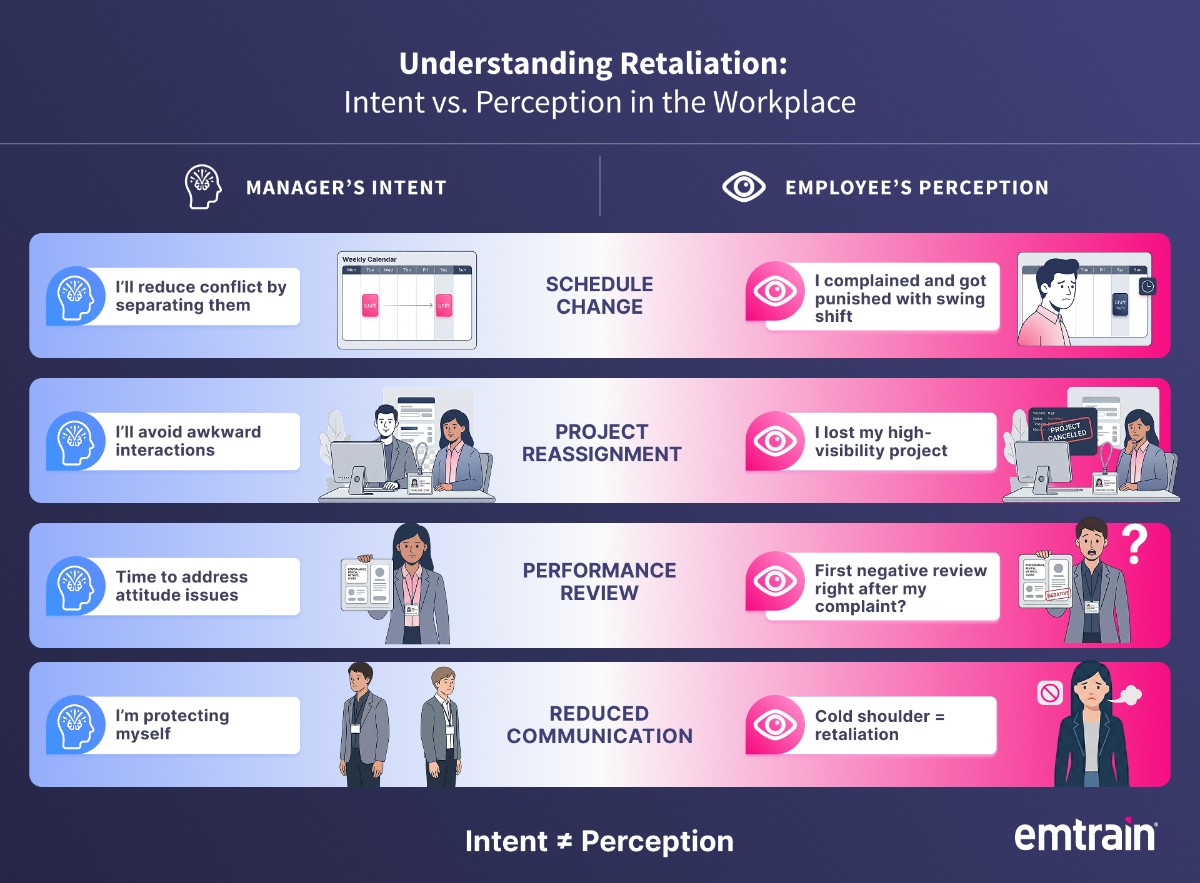
Ash makes a complaint to his manager about their teammate Ryan who is sexually harassing another coworker. Soon after, the manager tells Ash he’ll be working the swing shift, describing it as a temporary scheduling change “to meet increased production demands.” Watch this scenario unfold in Emtrain’s retaliation training videos.
The manager’s mistake: taking a negative employment action (schedule change) immediately following the employee’s protected activity (harassment complaint). Even though the manager intended to reduce workplace tension, the timing creates an unmistakable causal connection that establishes a prima facie retaliation case.
The better approach: Work with HR to investigate and address Ryan’s harassing behavior directly. The solution to harassment is stopping the harasser, not moving, isolating, or otherwise negatively impacting the employee who complains.
Watch the video scene below:
The Manager’s Dilemma: Balancing Effective Management and Legal Protection
Managers face genuinely difficult decisions after employees raise complaints. They must maintain team productivity, address interpersonal conflicts, and make necessary staffing decisions while remaining acutely aware of how their actions might appear following a complaint.
This balancing act becomes particularly challenging when the complaint itself involves team dynamics that the manager believes need addressing. For example, if an employee complains about being interrupted in meetings, the manager might already be frustrated with that employee’s communication style. The manager’s planned feedback about improving meeting participation suddenly becomes legally dangerous after the discrimination complaint.
The solution is not to avoid managing—it’s to manage thoughtfully with HR partnership. Managers who need to take employment actions affecting a complainant should work with HR to thoroughly document the business rationale, ensure consistency with past practices, and verify the action would have occurred regardless of the complaint.
Help Managers recognized Intent vs Perception with our Infographic you can download for free.
Best Practices for Managers
- Develop protocols that protect both the organization and your ability to manage effectively.
- Immediately flag any statement that could constitute a protected complaint to HR, even if the employee doesn’t use formal terms like “harassment” or “discrimination.”
- Look for complaints about unfair treatment related to protected characteristics, concerns about safety or ethics, and requests for accommodations.
- Pause all planned negative employment actions affecting the complainant until you’ve consulted with HR. Actions include demotions, schedule changes, performance improvement plans, project reassignments, exclusions from meetings, and any other changes that could be perceived as negative. Get clear guidance from HR before proceeding, even when business needs seem urgent.
- Work with HR to investigate and address the underlying complaint rather than managing around it. If harassment occurred, discipline the harasser. If discrimination exists, fix the system. If safety violations are happening, correct them. Don’t solve problems by moving, isolating, or otherwise disadvantaging the person who raised concerns.
- Document your management decisions consistently over time, not suddenly after complaints emerge. If you need to address performance issues, do so in real time with regular feedback and clear documentation. Patterns of documentation that begin immediately after a complaint raise obvious red flags.
How Emtrain Supports Managers in Preventing Retaliation
Managers need practical training that goes beyond legal definitions to show how everyday decisions create retaliation risk. Emtrain’s Harassment Prevention course teaches protected characteristics, while the Managing Within the Law course teaches managers how to appropriately handle discipline, accommodations, terminations; any of these actions following a complaint creates legal exposure.
Through realistic video scenarios and interactive lessons, managers learn to identify the early warning signs of potential retaliation situations and develop the discipline to consult HR before taking post-complaint actions. This scenario-based approach helps managers internalize best practices while building the judgment they need to navigate complex situations.
For HR Professionals: Preventing retaliation requires systematic education of people managers who may not recognize protected activities or understand causal connection principles. HR teams should implement regular training that addresses both legal requirements and practical scenarios managers face. Emtrain’s platform allows HR to track which managers have completed retaliation training and measure comprehension through assessment tools. Emtrain also measures retaliation risk on its intelligence platform, based on employee responses to questions during training.
For L&D Professionals: Effective anti-retaliation training must move beyond policy review to behavior change. Learning leaders should select programs that use realistic workplace scenarios showing how well-intentioned managers inadvertently retaliate. Emtrain’s video-based microlessons demonstrate common mistakes in context, making the learning memorable and applicable. L&D teams can deploy these modules as part of new manager onboarding, annual compliance training, or just-in-time learning when managers are promoted or transferred.
Taking Action to Protect Your Organization
Retaliation prevention starts with awareness. When managers learn to recognize protected activities in all their forms and understand how timing creates causal connections, they gain the foundation needed to make better decisions. Combined with strong HR partnership and systematic training, organizations can create environments where employees feel safe speaking up and managers can lead effectively within legal boundaries.
Ready to equip your management team with practical retaliation prevention skills? Contact Emtrain to learn how our evidence-based training helps managers recognize complaints, understand legal risk, and build speak-up cultures where concerns are addressed rather than punished.