
From Friction to Strategic Advantage
Generational conflict often dominates workplace conversations about age diversity, but organizations that successfully navigate these tensions discover something valuable: mixed-generation teams outperform single-generation teams when managed well. The key is shifting from avoiding generational friction to actively leveraging it through structured collaboration and mentoring.
Research has shown that intergenerational mentoring fosters knowledge sharing, cohesion, and collaboration in multigenerational workplaces. Organizations with age-diverse teams experience better problem-solving and enhanced creativity when generational differences are effectively managed. But these benefits don’t happen accidentally—they require intentional strategies that transform potential conflict into productive partnership.
Understanding Positive Cross-Generational Dynamics
Complementary Problem-Solving Styles
Different generations bring distinct problem-solving approaches shaped by their career experiences:
- Baby Boomers offer judgment developed through decades of organizational experience, understanding of precedent, and awareness of political dynamics
- Generation X tends to provide pragmatic, results-oriented thinking with skepticism about process for process’s sake
- Millennials often lead with data-driven analysis, collaborative approaches, and have comfort with ambiguity
- Generation Z are digital-natives who were taught to expect innovation, thus often have a tendency to challenge assumptions
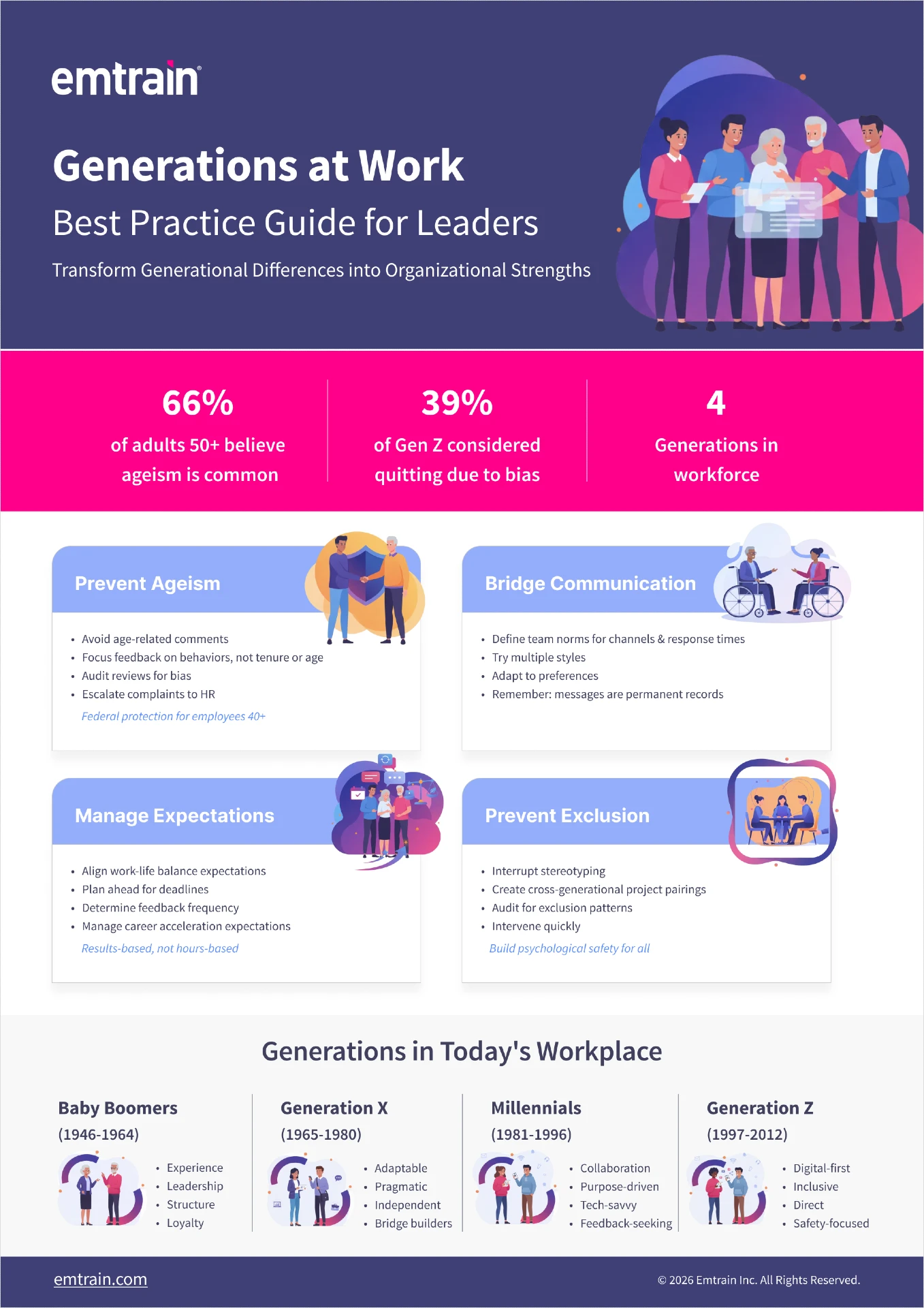
Experience-based intuition pairs well with experimental approaches. Mixed-generation teams often spot both risks and opportunities faster because they’re examining challenges through multiple lenses. Employees report stronger engagement when their unique contributions—whether institutional knowledge or emerging skills—are recognized and utilized. Download the Generations at Work Infographic for Leaders in our Resource Center:
The Mechanics of Effective Cross-Generational Mentoring
Beyond Traditional Top-Down Models
Traditional mentoring typically flows from older, more senior employees to younger, more junior ones. But effective cross-generational collaboration recognizes that learning should flow bidirectionally:
Older employees may provide:
- Institutional knowledge and understanding of organizational history
- Judgment honed by navigating similar situations previously
- Context about why certain practices exist
- Strategic advice on navigating organizational politics
- Mentoring on leadership presence and professional reputation
Younger employees may offer:
- Digital fluency and comfort with emerging technologies
- Exposure to new analytical tools and data visualization methods
- Fresh perspectives unburdened by “we’ve always done it this way” thinking
- Insight into evolving workplace expectations and social norms
- Understanding of how to engage audiences through modern communication channels
When organizations implement reverse mentoring—where younger employees formally mentor senior leaders—they signal that expertise takes multiple forms. This reduces age-based credibility hierarchies and builds mutual respect.
Creating Space for Informal Coaching Moments
While formal mentoring programs provide structure, informal coaching interactions often have greater impact on day-to-day collaboration. Imagine a quick conversation where an experienced employee explains why a particular stakeholder needs specific information that helps a younger colleague look good to a superior. Or, a younger employee showing an older colleague a more efficient workflow tool that saves hours of repetitive work. These moments work when there’s psychological safety—when asking questions or offering suggestions doesn’t trigger defensiveness or judgment.
Strategies for Building Cross-Generational Collaboration
1. Project-Based Pairing
Formal mentoring relationships help, but project-based partnerships often accelerate trust-building more effectively. When employees from different generations work together toward shared goals, age-based assumptions give way to appreciation for each other’s contributions.
Effective project pairing:
- Matches complementary skills rather than seniority levels
- Creates genuine interdependence where both partners need each other’s expertise
- Includes explicit discussion of how each person prefers to communicate and collaborate
- Focuses on outcomes rather than processes, allowing different work styles to coexist
Project partnerships differ from shadowing or observation—both parties actively contribute and make decisions together. This equality prevents the dynamic from feeling like older employees “teaching” younger ones, which can reinforce rather than reduce generational hierarchies.
2. Knowledge Transfer That Flows Both Ways
Organizations often focus on capturing institutional knowledge from experienced employees before they retire. This is important, but framing it as one-directional reinforces the idea that only older employees possess valuable knowledge.
Instead, create structured knowledge exchange:
- Senior employees document decision-making frameworks and organizational history
- Junior employees document emerging tools, methods, and market trends
- Both generations collaborate to identify where traditional approaches should evolve and where they should be preserved
This approach positions knowledge transfer as an organizational capability everyone contributes to rather than a generational handoff.
3. Establishing Cross-Generational Working Norms
When teams explicitly discuss and agree on working norms, generational preferences become transparent rather than sources of friction:
Communication preferences: “Some of us prefer Slack for quick questions; others prefer email. Let’s use Slack for urgent items and email for anything requiring documentation or detailed response.”
Meeting practices: “Some of us think better when we prepare in advance; others prefer real-time brainstorming. Let’s send agendas 24 hours ahead but leave room for spontaneous discussion.”
Feedback approaches: “Some of us want feedback immediately; others prefer scheduled check-ins. Let’s each share our preference and respect it.”
These conversations normalize differences without attributing them to generational labels.
Addressing Barriers to Cross-Generational Collaboration
Overcoming Stereotyping During Collaboration
Even with good intentions, generational stereotypes can undermine collaboration:
- Assuming older employees can’t learn new technologies
- Assuming younger employees lack strategic thinking capability
- Defaulting to age-based task division (“Let them handle the social media; I’ll handle the client relationship”)
Combat stereotyping by:
- Assigning tasks based on interest and skill development goals, not age
- Creating opportunities for everyone to work outside their perceived “generation’s strengths”
- Calling out age-based assumptions when they surface
- Celebrating examples where employees defy generational expectations
Creating Psychological Safety Across Generations
Collaboration fails when employees fear judgment for not knowing something or suggesting ideas outside their expected lane. Psychological safety—the belief that speaking up won’t result in punishment or embarrassment—is essential for cross-generational partnership.
Build psychological safety by:
- Modeling curiosity rather than criticism when encountering different approaches
- Normalizing questions and learning regardless of experience level
- Addressing age-based putdowns or dismissive comments immediately
- Recognizing that everyone has gaps in knowledge shaped by their specific experience
Managing Power Dynamics
When older employees also hold senior positions, cross-generational mentoring can replicate rather than challenge existing power structures. Reverse mentoring helps but requires careful implementation:
Do:
- Give junior employees real decision-making authority in their areas of expertise
- Create forums where junior employees can challenge senior leaders’ assumptions respectfully
- Evaluate senior leaders on their ability to learn from and implement insights from junior colleagues
Don’t:
- Frame reverse mentoring as “helping senior leaders understand young people”
- Allow senior leaders to treat reverse mentoring as a box-checking exercise
- Punish junior employees for surfacing uncomfortable truths during reverse mentoring
Measuring Cross-Generational Collaboration Success
Organizations should track whether cross-generational initiatives are actually reducing conflict and improving performance:
Quantitative Indicators:
- Employee engagement scores across age cohorts
- Retention rates for both early-career and experienced employees
- Participation rates in mentoring programs across generations
- Demographics of promotion and development opportunities
Qualitative Indicators:
- Frequency of age-related complaints or conflicts
- Employee descriptions of whether different age groups’ opinions are valued equally
- Evidence of knowledge transfer in both directions
- Examples of cross-generational partnerships producing better outcomes than single-generation approaches
Regular assessment prevents cross-generational programs from becoming performative rather than transformative.
The Business Impact of Getting This Right
Organizations that successfully leverage generational diversity report:
- Faster innovation cycles: Combining risk awareness with experimentation produces balanced innovation
- Better talent retention: Employees who feel valued for their unique contributions regardless of age stay longer
- Improved knowledge continuity: Bidirectional knowledge transfer prevents critical information loss
- Enhanced problem-solving: Multiple perspectives catch blind spots and generate more creative solutions
- Stronger employer brand: Reputation for age inclusion attracts talent across career stages
Conversely, organizations that allow generational conflict to fester lose competitive advantage as employees self-segregate by age, knowledge silos form, and talent from certain age groups exits.
Moving From Conflict to Collaboration
Generational conflict is real, but it’s not inevitable that conflict damages organizations. The difference lies in whether leadership views generational diversity as a problem to manage or an asset to leverage.
By creating structured opportunities for cross-generational mentoring, establishing bidirectional knowledge transfer, and building psychological safety across age groups, organizations transform generational tension into competitive advantage.
The key is intentionality: designing systems that actively bring different generations together rather than allowing them to self-segregate. When shared goals replace identity-based assumptions, teams build the kind of trust that makes generational diversity a source of strength.
Ready to transform generational dynamics in your organization? Contact us to learn how Emtrain’s training programs and resources can help you build high-performing, age-diverse teams.