
Why Smart Managers Still Make Retaliation Mistakes
Workplace retaliation is the most frequently filed charge with the EEOC, surpassing even the underlying discrimination and harassment claims. Yet most retaliation isn’t intentional punishment—it’s the result of well-meaning managers making reactive decisions without recognizing the legal implications. Understanding retaliation requires managers to recognize something counterintuitive: their intent doesn’t matter as much as the appearance and impact of their decisions.
Managers typically stumble into retaliation territory because they’re focused on solving immediate problems. An employee complains about harassment, creating team tension. The manager tries to reduce conflict by separating the employees. A diversity leader raises concerns about pay disparities that the organization decides not to fix; her manager suggests she might be happier in a different role. An employee with a disability accommodation isn’t meeting metrics, so the manager shifts work away from them.
These reactions feel reasonable in the moment. But when they occur shortly after protected activities, they establish a pattern that employment lawyers and EEOC investigators recognize instantly: protected activity, followed by negative job action, with an obvious causal connection. That’s the legal definition of retaliation, regardless of the manager’s intentions.
Mistake 1: The Emotional Challenge—Taking Complaints Personally
When an employee files a complaint against a manager or about workplace conditions the manager oversees, it can feel like an attack on their professionalism, judgment, and character. This emotional reaction is natural. Managers who pride themselves on fairness may feel unfairly accused. Those who work hard to support their teams may feel betrayed by an employee’s complaint.
These emotional responses create danger when they influence management decisions. A manager who feels personally attacked may become less friendly toward the complainant, provide less mentoring, assign less interesting work, or exclude them from informal gatherings. Each of these subtle changes can constitute retaliation.
The Solution
Separate your emotional reaction from your professional responsibilities. Recognize that employees have a legal right to raise concerns, even when those concerns prove unfounded. The complaint isn’t necessarily about you personally—it may reflect the employee’s perception, past experiences, or genuine concerns you weren’t aware of.
Before making any decisions affecting a complainant, ask yourself: “Am I responding to business needs or to my emotional reaction?” If you’re uncertain, that’s precisely when you need HR guidance.
Mistake 2: The Reactive Decision Trap—”Solving” Problems by Moving People
Managers often make reactive choices following complaints that aren’t intended as punishment but still negatively impact the complainant. The most common example: separating employees to reduce conflict.
Consider this scenario: Julie complains to HR that her manager gives away her sales leads when she needs to take medical leave for migraines, saying “he knows I have migraines and when I do, he gives my leads away and says I’m ‘not showing up for work.'” This complaint combines disability discrimination and potential harassment—both protected activities.
The manager might think, “I’ll reassign Julie to different accounts that don’t require such immediate response times. That way her migraines won’t impact her performance.” This sounds helpful. But reassigning the employee to less desirable work immediately following her complaint about disability discrimination constitutes textbook retaliation.
Watch the video below:
The Solution
The issue isn’t Julie’s migraines or her need for accommodation—it’s the manager’s unequal treatment. The correct response is ensuring Julie receives equitable opportunities while honoring her disability accommodation. Work with HR to develop systems that distribute leads fairly when any employee is unavailable, not just employees with medical conditions.
More broadly, resist the urge to “solve” complaint-generated tension by moving, isolating, or changing the complainant’s role. Address the underlying problem—the harassment, the discrimination, the inequitable treatment—rather than managing around it.
Mistake 3: The Follow-On Freeze Effect—Not Recognizing the Causal Connection
The timing and nature of events creates an unmistakable causal link between complaints and subsequent negative actions. Employment lawyers call this “temporal proximity”—when a negative action follows closely after a protected activity, the timing itself creates an inference of retaliation.
How close is too close? Courts have found temporal proximity with gaps of days, weeks, or even months. Any significant employment action taken within several months of a protected activity will be scrutinized for retaliatory intent. This includes terminations, demotions, poor performance reviews, schedule changes, project reassignments, and exclusions from opportunities.
Sara complains during a virtual team meeting that she has three male coworkers “who speak for me, restate my ideas as their own.” This is a gender discrimination complaint. Shortly after, her manager excludes her from a key client project, explaining to others, “Let’s not loop in Sara. Let’s just figure this out ourselves.”
The manager may have genuinely believed Sara’s participation would create conflict. But excluding an employee from projects immediately after she raises a discrimination complaint creates obvious causal connection, establishing a retaliation claim regardless of the manager’s stated business justification.
Watch the video below:
The Solution
Implement a “complaint cooling-off period” for management decisions. After any employee raises a complaint, formal or informal, pause all negative employment actions affecting that employee for at least 90 days unless you have thoroughly documented business justification developed with HR guidance.
If you must take action during this period due to genuine business needs, work with HR to establish clear documentation showing the decision would have been made regardless of the complaint. This documentation should exist before the action is taken, not created retroactively.
Mistake 4: No Documentation Discipline—Reactive Performance Management
Managers who are managing challenging situations often don’t create adequate documentation. They’re busy, frustrated, and they already know what management action they need to take. But without contemporaneous documentation showing an ongoing performance concern, any negative action taken after a complaint looks retaliatory.
This pattern is common: An employee performs adequately for months or years with no documented concerns. The employee raises a complaint about harassment or discrimination. Suddenly, the manager begins documenting performance problems, implements a performance improvement plan, or proposes termination.
Even if the performance issues are genuine, the sudden appearance of documentation immediately following a complaint creates damning optics. Investigators and juries see an obvious pattern: the complaint triggered the manager’s decision to document and take action, rather than actual performance decline.
The Solution
Document performance consistently over time, not suddenly when you want to take action. Provide regular feedback, both positive and constructive. Address concerns as they arise through real-time conversations and follow-up emails. Create performance improvement plans when issues first emerge, not after complaints are filed.
This consistent documentation serves two purposes: it allows you to take necessary employment actions even after complaints (because you can demonstrate the pattern existed before the complaint), and it improves employee performance by providing clear, timely feedback rather than surprising employees with suddenly “discovered” problems.
Organizations should provide training that helps managers understand documentation requirements and best practices. Emtrain’s Managing Within the Law course includes specific guidance on documentation practices that protect both the manager and the organization.
Mistake 5: Accepting HR’s Guidance—The Power and Pride Problem
It can be difficult for managers in positions of authority who see their side clearly to pause and follow HR’s advice. Managers may feel they know their team better than HR does. They may be confident their decisions are fair and business-justified. They may resist what feels like HR interference in their management authority.
But when dealing with retaliation, manager actions have impact, and sometimes inaction is the appropriate response. HR professionals understand the legal landscape, recognize risk patterns, and can see how decisions will be perceived by investigators and courts. Their guidance exists to protect both the organization and the manager.
Consider the manager who wants to put an employee on a performance improvement plan shortly after that employee complained about age discrimination. The manager has legitimate performance concerns. But HR advises waiting 90 days and documenting more thoroughly first. The manager who proceeds against HR’s advice exposes both themselves and the organization to significant legal risk.
The Solution
View HR as a strategic partner rather than an obstacle. When HR advises pausing an employment action, they’re not questioning your judgment about the underlying performance or business issue—they’re helping you navigate the legal and procedural requirements for taking that action safely.
Develop the habit of early consultation with HR. Don’t wait until you’ve decided to terminate or demote an employee to involve HR. Instead, flag any complaint immediately, discuss your planned management approach, and incorporate HR’s guidance into your decision-making process from the start.
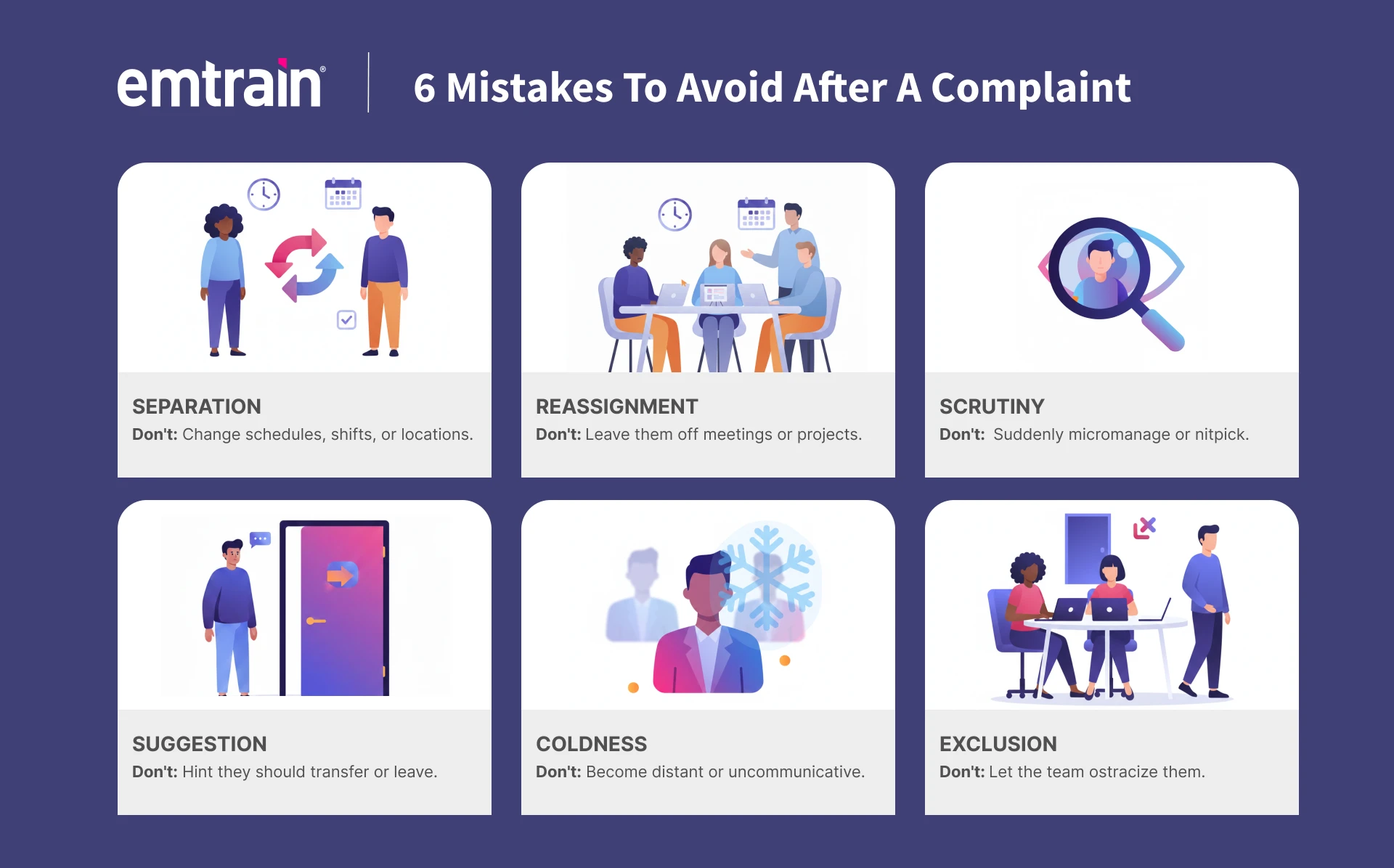
Help your Managers to Recognize Retaliation with our Infographic Reminder
How Training Prevents These Common Mistakes
Effective retaliation prevention requires training that addresses not just legal definitions but the psychological and practical challenges managers face. Managers need to see realistic scenarios showing how their natural reactions create problems, understand the specific documentation and consultation practices that reduce risk, and develop new habits for responding to complaints.
Emtrain’s scenario-based training demonstrates these common mistakes in context, helping managers recognize when they’re falling into familiar traps. By watching other managers make these errors and learning the corrective approaches, managers build better instincts for navigating complex situations.
For HR Professionals: Retaliation prevention requires ongoing vigilance and manager education. HR teams should use Emtrain’s platform to measure which managers have completed training, track comprehension through assessments, and identify high-risk managers who may need additional coaching. The HR reporting and retaliation analytics in Emtrain Intelligence provide leading indicators of retaliation risk before complaints escalate to legal claims, allowing HR to intervene proactively.
For L&D Professionals: Traditional compliance training that lectures about retaliation laws fails to change manager behavior because it doesn’t address the emotional and practical challenges that lead to mistakes. L&D teams should implement scenario-based learning that shows managers recognizing their own patterns and developing better responses. Emtrain’s microlesson format allows managers to learn in digestible segments that fit into busy schedules while the realistic scenarios make the learning stick.
Moving Forward: Building Better Management Habits
Avoiding retaliation isn’t about eliminating your authority to manage—it’s about managing thoughtfully with awareness of timing, optics, and legal implications. When you recognize the common traps, consult with HR before taking action, and document consistently over time, you can address genuine performance and business issues while protecting both your employees and your organization.
The goal is building management habits that serve you well in all circumstances, not just after complaints. Managers who provide regular feedback, document contemporaneously, consult with HR on sensitive situations, and separate their emotional reactions from their professional decisions are more effective leaders overall.
Ready to help your managers avoid these common retaliation mistakes? Contact Emtrain to request our Retaliation Prevention Checklist, learn how our evidence-based training builds awareness and develops better management habits that reduce legal risk while improving team dynamics.