Ethics and compliance refers to the policies, standards, behaviors, and decision-making practices that help employees act responsibly, follow applicable laws, and protect the organization from legal, financial, and reputational risk.
Strong ethics and compliance programs do more than explain rules. They help employees recognize risk, apply company values to real workplace situations, and make better decisions when the right answer is not always obvious.
Emtrain’s harassment training course is engaging, interactive, and designed to spot and reduce EEO risk.
Ethics and compliance are closely connected, but they are not exactly the same.
Compliance focuses on following laws, regulations, policies, and established business requirements.
Ethics focuses on how employees make responsible decisions—even when a policy or regulation does not provide an obvious answer.
Together, ethics and compliance create a framework for how employees are expected to behave, make decisions, raise concerns, protect company information, and interact with customers, coworkers, vendors, regulators, and business partners.
A strong workplace ethics and compliance program helps employees understand both what the rules require and how to apply them in real situations.
Employees make decisions every day that can create or reduce risk.
Those decisions may involve:
Without clear guidance and practical training, small decisions can turn into much larger compliance problems.
An effective ethics and compliance program can help organizations:
Modern ethics and compliance programs cover much more than a traditional employee code of conduct.
Depending on an organization’s industry, workforce, and risk profile, important topics may include:
A company’s code of conduct establishes the values, behavioral expectations, and business standards employees are expected to follow.
Effective Code of Conduct training helps employees understand how those standards apply to everyday decisions involving conflicts, gifts, company resources, reporting, confidentiality, and professional conduct.
A conflict of interest can arise when an employee’s personal, financial, or professional interests interfere—or appear to interfere—with their responsibilities to the organization.
Conflicts of Interest training can help employees recognize potential conflicts and understand when disclosure or additional guidance is necessary.
Artificial intelligence has created a new set of ethical and compliance risks involving privacy, intellectual property, accuracy, bias, confidential information, and accountability.
AI Governance training helps employees understand how to use AI responsibly and when human review or organizational approval may be necessary.
Employees routinely work with copyrights, trademarks, patents, trade secrets, proprietary processes, and other valuable information.
Protecting Intellectual Property training helps employees understand what company information needs protection and how everyday decisions—including AI and open-source software use—can create IP risk.
Cybersecurity is not only an IT responsibility.
Employees can create or reduce security risk through decisions involving passwords, phishing emails, credentials, file sharing, social engineering, and handling sensitive data.
Cyber Security training helps employees recognize common threats and understand their responsibility for protecting organizational information.
Employees who work with customer, employee, patient, or partner information need to understand how personal data should be collected, used, stored, and shared.
Global Data Privacy training helps employees recognize privacy risks and make more responsible decisions when handling personal information.
Employees interacting with customers, vendors, partners, or government officials may encounter gifts, payments, favors, or incentives that create legal and ethical risk.
Global Anti-Bribery and Corruption training helps employees identify bribery and corruption red flags and understand when a situation should be escalated.
Employees need to know how and when to report suspected wrongdoing.
Whistleblower Training helps employees understand reporting channels, retaliation concerns, and their role in creating a workplace where people feel comfortable speaking up.
Employees who have access to confidential business information may encounter material nonpublic information that creates securities law risks.
Insider Trading training helps employees recognize those situations and understand restrictions involving trading, tipping, and sharing confidential information.
For certain industries and employee roles, ethics and compliance also include identifying financial activity that may involve money laundering or other suspicious transactions.
Anti-Money Laundering training can help employees recognize red flags and understand when additional review or reporting is required.
Employees working in sales, pricing, procurement, partnerships, or trade associations may face risks involving competitor communications or anti-competitive behavior.
Antitrust Compliance & Competition training helps employees recognize conduct involving price fixing, bid rigging, market allocation, and other competition risks.
Companies operating internationally may need employees to understand export controls, sanctions, restricted parties, and other trade requirements.
Global Trade Compliance training helps employees recognize when international transactions or business relationships may create additional compliance obligations.
Many traditional compliance programs focus primarily on communicating policies and documenting course completion.
But employees rarely experience workplace risk as a multiple-choice question about a regulation.
They experience it as a decision:
Can I accept this gift?
Should I report what I saw?
Can I put this information into an AI tool?
Is this relationship a conflict of interest?
Can I share this information with someone outside the company?
That is why effective ethics and compliance training should use realistic workplace situations that give employees an opportunity to recognize risk and practice decision-making.
Emtrain’s Ethics & Compliance courses combine scenario-based learning, expert guidance, employee polling, and short reinforcement lessons to help organizations move beyond check-the-box training.
Explore Emtrain’s Ethics & Compliance Courses
An effective program usually combines several elements rather than relying on one annual course.
Employees should understand the organization’s values, policies, code of conduct, and expectations for ethical behavior.
Training should reflect situations employees are likely to encounter instead of focusing only on abstract rules.
Different employees face different compliance risks.
A finance team may require deeper AML or insider trading education, while engineering teams may need additional guidance around intellectual property, AI, and open-source software.
Employees should know where to ask questions and how to report potential misconduct.
A strong speak-up culture makes it easier to identify issues before they become larger legal or reputational problems.
Ethical decision-making is a skill.
Short microlessons and scenario-based reinforcement can help employees continually practice that skill rather than treating compliance as an annual event.
Training completion tells an organization whether an employee finished a course.
It does not necessarily tell leaders where employees are confused, where risky norms exist, or which teams may need additional support.
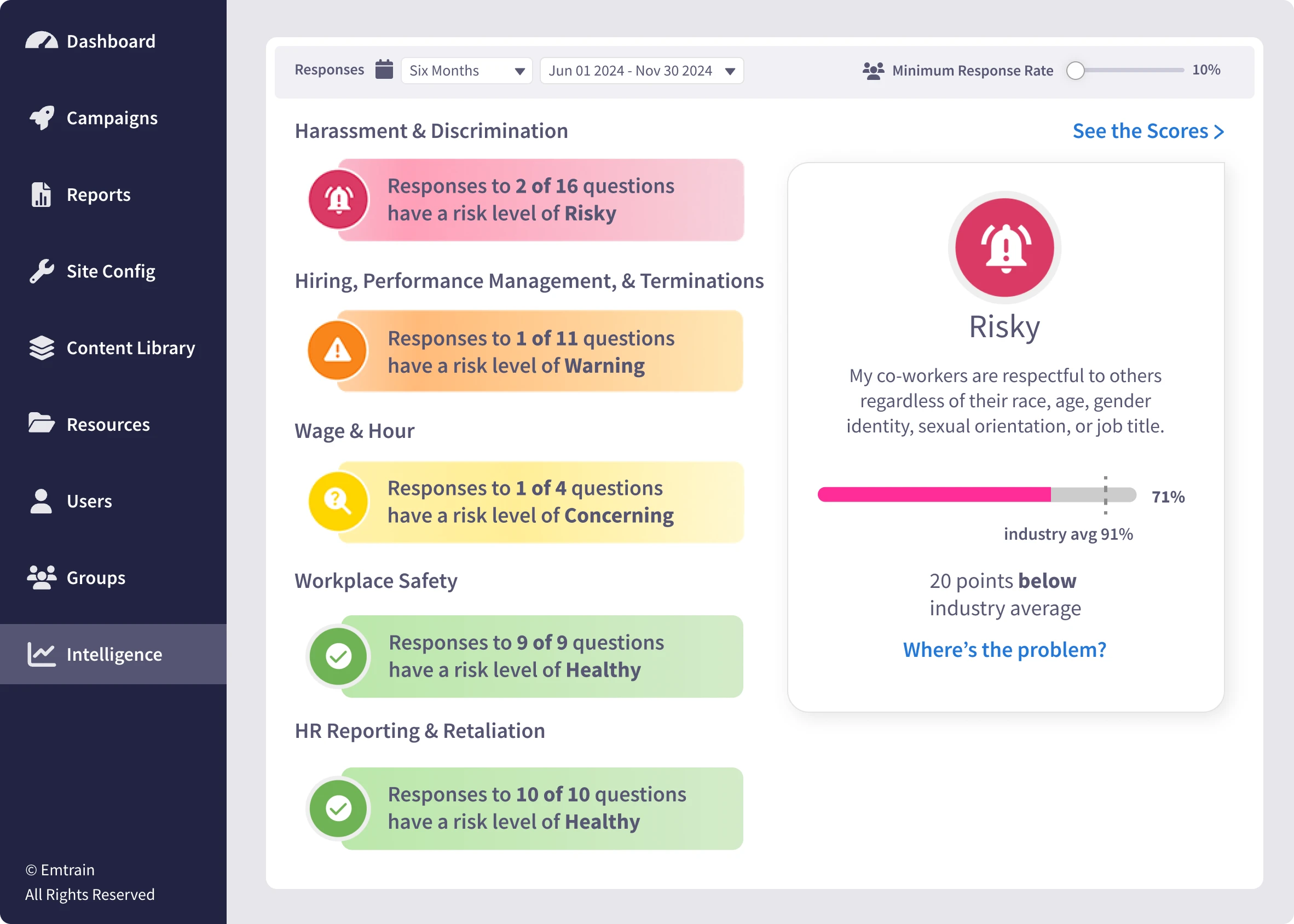
Emtrain Intelligence uses employee responses embedded within training to help organizations identify business compliance risk and compare results across risk areas and organizational groups. Emtrain currently measures areas including Code of Conduct, Data Privacy & Information Security, Bribery & Corruption, Antitrust & Fair Competition, and Reporting & Whistleblowing.
Organizations looking specifically for guidance on employee ethics education can also explore our in-depth guide:
Ethics Training for Employees: Essential Topics for 2026
The guide covers the essential topics employers should consider when developing an ethics training program, including Code of Conduct, AI Governance, conflicts of interest, cybersecurity, data privacy, whistleblowing, intellectual property, anti-bribery, and more.
Ethics and compliance are not simply about avoiding violations.
They help organizations create consistent expectations for how employees make decisions, protect information, interact with others, and respond when something does not seem right.
When policies, practical training, employee feedback, and risk measurement work together, organizations can move from simply documenting compliance to actively identifying and reducing business risk.