
You have seen it all before. A manager asks the team for feedback.
Everyone says the idea looks great.
Meeting over. Decision made.
Except that’s not what the team actually thinks. Watch this scene play out:
In this workplace scenario, Mark presents his latest designs and asks his team for their thoughts. Out loud, he hears:
“Cool.” “Wow.” “Those look great.”
But internally, his employees are having a very different conversation.
One employee thinks part of the design is in the wrong place. Another believes the team needs a data scientist. Another isn’t confident she understands data visualization well enough to challenge the direction.
Nobody says any of it.
The manager asked for feedback. The employees didn’t feel comfortable giving it.
This is one of the challenges with feedback in the workplace: creating an opportunity for employees to speak isn’t necessarily the same as creating an environment where they feel safe doing it.
Why Don’t Employees Share Feedback at Work?
There could be dozens of reasons.
An employee might not want to challenge a manager who has already invested in an idea. They may worry that criticism will be interpreted as negativity. They may lack confidence in their own expertise. Or they may have learned from previous experiences that speaking up doesn’t change anything.
And increasingly, employees may also find themselves questioning decisions or recommendations that originate with AI.
When an AI-generated answer is presented as the solution, does your team feel comfortable saying:
“I don’t think that’s right.”
Research suggests this is a real concern. A 2025 study on algorithmic conformity found that people sometimes followed incorrect AI recommendations even when they were capable of reaching the correct answer themselves. Researchers found that this tendency was partly associated with discomfort at disagreeing with AI.
The underlying workplace skill hasn’t changed. Employees need enough trust to question assumptions, challenge ideas and offer another perspective — regardless of whether the original idea came from a manager, colleague or AI tool.
But there’s a larger problem for HR and compliance leaders:
How do you know whether employees are holding back?
You have to ask them.
Compliance Training Can Be a Listening Tool
Most organizations think of compliance training as something employees receive.
Assign the course.
Complete the training.
Record the completion.
But training can also be an opportunity to listen to employees at scale.
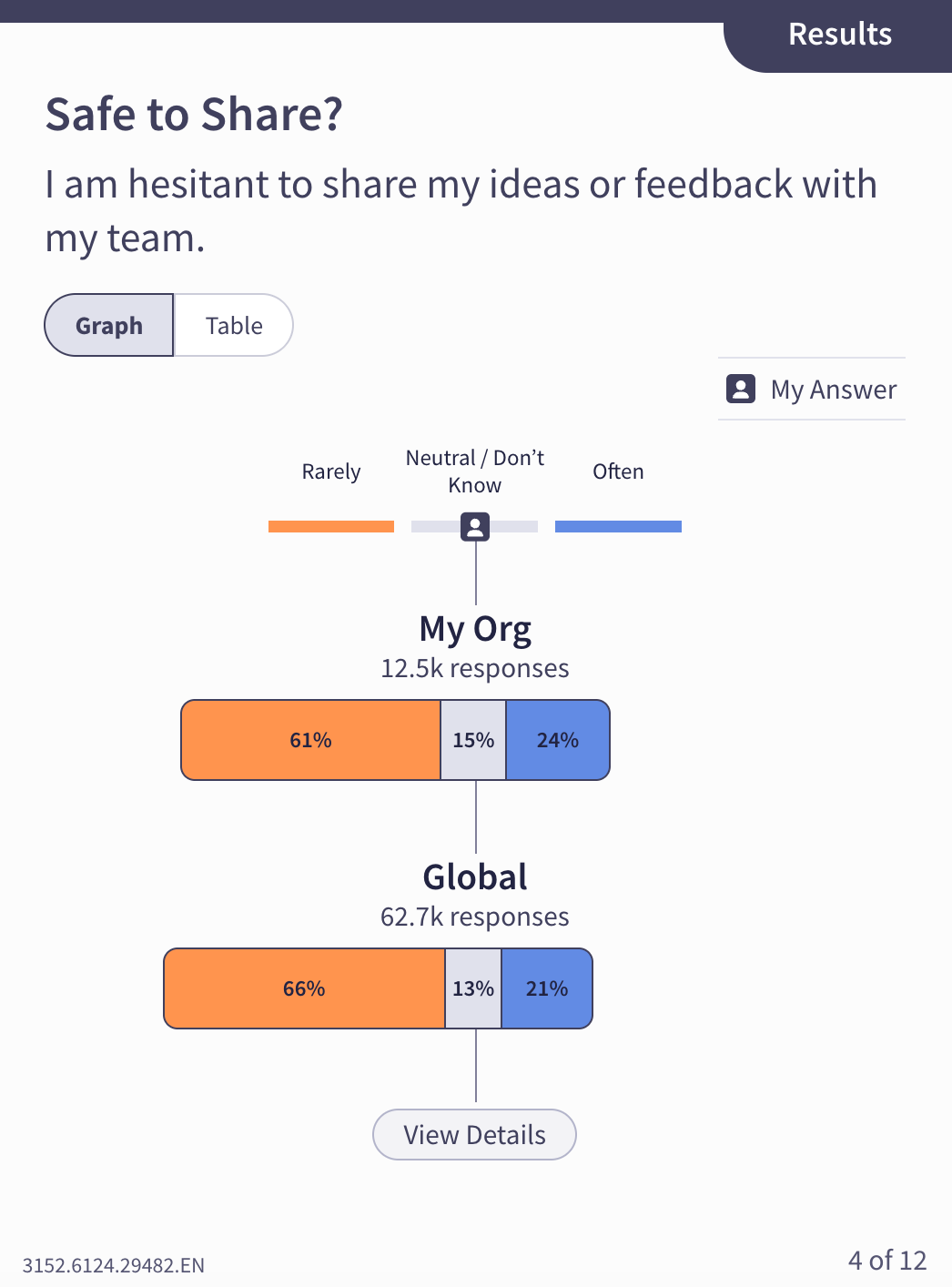
Emtrain asks employees questions directly within the learning experience. In our Code of Conduct training, for example, employees encounter a lesson on workplace norms, trust and accountability and are asked:
“I am hesitant to share my ideas or feedback with my team.”
Across more than 62,000 responses, 21% say this happens often.
That changes what compliance training can tell you.
A completion report tells you that employees finished the training.
Their answers can tell you where the organization may still have work to do.
And because responses can be benchmarked, HR and compliance teams can begin looking beyond a raw percentage to understand whether what they’re seeing is typical — or a workplace norm that deserves attention.
That is the difference between training employees at your organization and learning from your organization.
Feedback in the Workplace Starts With Trust
Employees can’t provide meaningful feedback simply because a manager says, “My door is always open.”
There needs to be trust.
Trust creates the comfort employees need to surface workplace issues before they become bigger problems. It allows people to share ideas, question decisions, admit uncertainty and give feedback while trusting that their colleagues will listen with empathy and an open mind.
Think about what changes when that trust exists.
More good ideas get shared. Challenges become visible earlier. Teams see opportunities they might otherwise miss. And potential mistakes can be questioned before they turn into bad decisions.
That makes feedback more than a communication skill.
It’s an early-warning system.
Asking for Feedback Isn’t Enough
There’s another side to this workplace scenario.
Employees need the skills and confidence to speak up — but managers and coworkers also need the skills to receive what they hear.
Imagine Jack had actually said:
“I don’t think that element belongs there. End users don’t need it, and I’m concerned stakeholders won’t see it.”
What happens next?
If the response is defensive, dismissive or punitive, Jack learns something very quickly: don’t do that again.
Healthy feedback requires skills on both sides of the conversation.
Employees need to know how to communicate concerns constructively. Managers need to actively listen, ask questions and resist immediately defending their decisions. Teams need to be able to disagree without turning disagreement into conflict.
That’s how individual behaviors eventually become workplace norms.
From Listening to Skill Building
This is where listening through compliance training becomes useful.
Finding a problem isn’t the end goal.
It tells you what to teach next.
If employee responses indicate that people are hesitant to share feedback, organizations can reinforce the specific skills connected to that behavior instead of waiting until next year’s annual training.
For example, Emtrain can reinforce those behaviors with targeted microlessons such as:
- Foster a Healthy Workplace — build workplace norms that encourage trust and constructive communication.
- Giving Fast and Effective Feedback — help employees provide useful feedback in the moment.
- Facing Criticism — develop the skills to receive difficult feedback productively.
- Active Listening Skills — help employees and managers listen to understand rather than simply waiting to respond.
Accountability plays a role too. Employees need to understand their responsibilities, keep commitments, give feedback when others don’t, and — importantly — listen and ask for feedback themselves.
Instead of assigning the same training again and hoping workplace behavior changes, you can use what employees told you to determine which skills need reinforcement.
The Training → Listening → Action Loop
This is the bigger opportunity for compliance teams.
Imagine annual compliance training working like this:
Teach a workplace concept → Ask employees about their experience → Benchmark the responses → Identify areas of concern → Reinforce the relevant skills → Measure again
Now the training isn’t only documenting that the organization delivered required content.
It’s helping HR and compliance leaders understand what’s actually happening inside their workplace.
That matters because many workplace risks don’t begin as formal complaints.
They begin as smaller signals.
- Someone stops challenging a manager.
- Someone decides an idea isn’t worth sharing.
- Someone notices a problem but assumes leadership doesn’t want to hear it.
- Someone stays silent in a meeting.
One instance may seem insignificant. A pattern across a team, department or organization can tell a very different story.
Can Your Compliance Training Hear That?
If you want to uncover workplace risk, you have to ask the right questions at the right time.
That’s why Emtrain combines workplace scenarios, employee questions, benchmarking and skills-based learning.
We don’t just want to know whether employees completed the training. We want to understand what their responses tell us about the workplace.
Then we can use those workplace insights to reinforce the skills that need attention — throughout the year, not just during an annual compliance event.
Because when 21% of employees say they often hesitate to share their ideas or feedback, the training may be complete.
But the work isn’t.
Turn Compliance Training Into a Listening Tool
Discover how Emtrain uses realistic workplace videos, employee sentiment questions, benchmarking and targeted skills training to help organizations identify and address workplace risk.