
We all make assumptions about other people.
Sometimes we know we’re doing it. Other times, our brains make judgments before we’ve consciously thought about them.
That’s unconscious bias—and simply knowing the definition doesn’t necessarily stop it.
So instead of just giving you a list of common types of bias in the workplace, we’re going to put you into a few situations employees encounter every day.
See what you notice. See what you assume. And then ask yourself: would bias affect what you do next?
What Is Unconscious Bias?
Unconscious bias, sometimes called implicit bias, happens when an unknown error in our thinking leads us to make assumptions about another person.
When our view of someone or a situation is incomplete, our brains naturally try to fill in the gaps. Sometimes those shortcuts are useful. Other times, they lead us to incorrect conclusions about people.
Think about the autocomplete feature on your phone.
It uses patterns and limited information to predict what you’re trying to type. Most of the time, it can be helpful.
But sometimes it gets the prediction completely wrong.
Our brains can work in much the same way. We use stored patterns based on our experiences, culture and the media we consume to quickly make sense of the people and situations around us.
The problem comes when those mental shortcuts influence how we treat someone without us stopping to question whether our assumptions are actually true.
Before We Start: Can You Pass This Bias Test?
Look at the two people in this video. Who do you think is the teacher? The lawyer? The executive assistant?
Did you have an answer?
Why?
You haven’t met either person. You don’t know their education, experience, profession, skills or background.
The only information you have is what they look like.
If you found yourself making an assumption, that’s the point of the exercise.
Our brains develop mental images of what a lawyer, executive, teacher, assistant—or almost anyone else—is supposed to look like. We may not consciously retrieve those images, but they can influence our expectations.
And those expectations can follow us into the workplace.
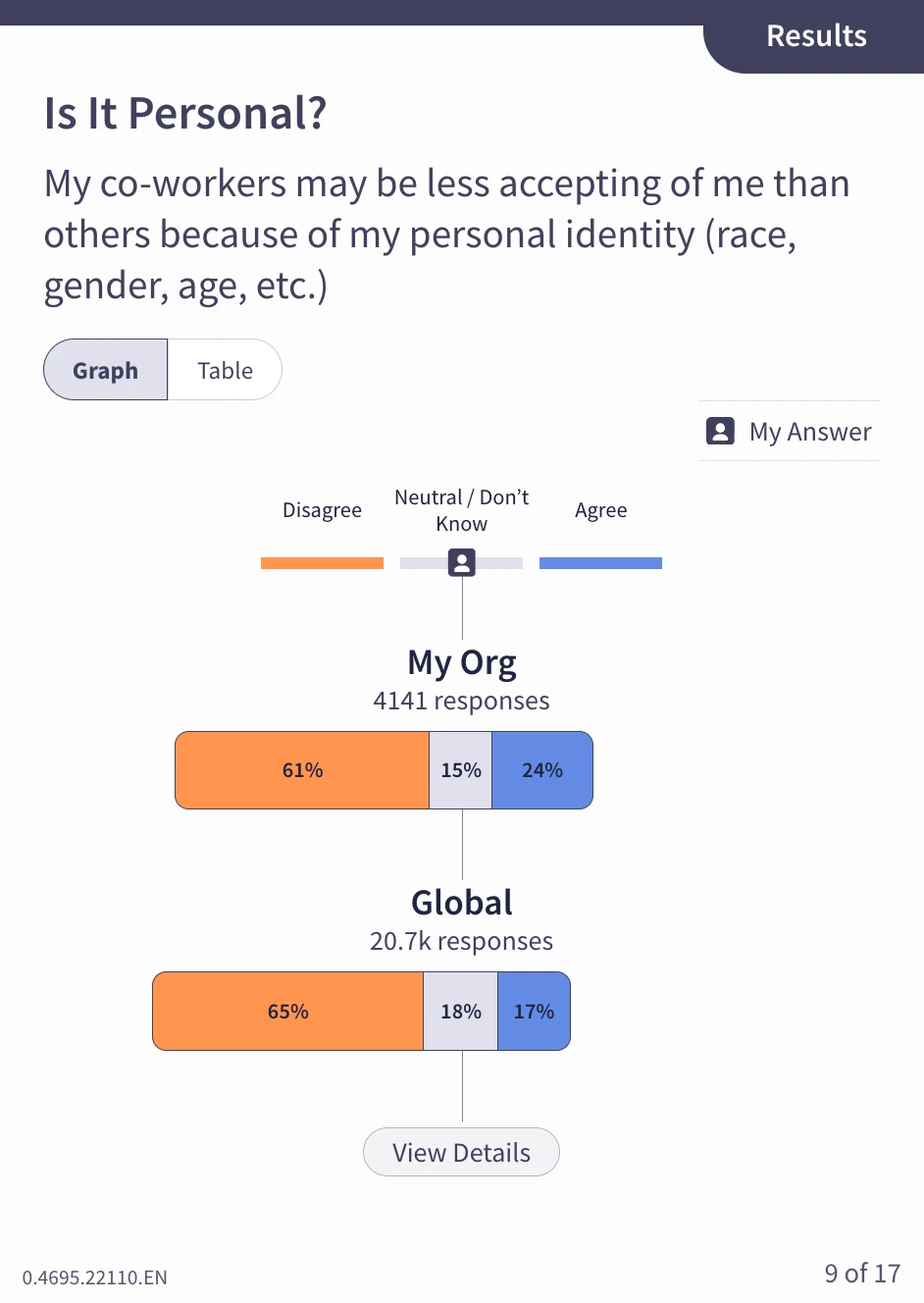
Emtrain’s Recognizing Bias at Work microlesson asks employees whether they believe coworkers may be less accepting of them because of a personal identity such as race, gender or age. Across Emtrain’s global responses, 17% agreed that this was their experience.
So let’s look more closely at three common types of workplace bias and, more importantly, what they can actually look like when they happen.
1. Race and Cultural Background Bias
Race and cultural background can influence assumptions about another person before we’ve learned much about them.
Those assumptions might involve someone’s education, socioeconomic background, language ability, family history, professional experience or position within an organization.
And they don’t always sound overtly negative.
Watch: What assumption did he just make?
At first, the conversation might seem harmless. The employee may even believe he’s showing an interest in his coworker’s background.
But consider the assumption underneath the conversation.
What information does he actually have about his coworker’s family’s educational background?
None.
His coworker’s perceived racial or cultural identity filled in information that was never provided.
That’s one reason bias can be difficult to recognize in real time. It doesn’t always arrive as an obviously discriminatory comment. Sometimes it appears as an assumption that feels so natural to the person making it that they never stop to question where it came from.
Now watch another example.
Again, ask yourself:
What information led him to that conclusion?
Recognizing the assumption is the first step toward preventing it from affecting how we evaluate or interact with coworkers.
2. Gender Bias
Gender bias can shape our expectations of men, women, transgender people and nonbinary people, including assumptions about the jobs, responsibilities and behaviors we associate with different genders.
It can be especially easy to spot when someone else does it.
The harder question is whether we recognize it in ourselves.
Watch: Who did he assume was the CEO?
Nobody had to say, “CEOs are men.”
The assumption was already there.
The employee had a mental image of the person who belonged in that meeting, and the woman walking into the room didn’t match it.
That’s unconscious bias at work.
Gender bias can influence assumptions about who should lead a meeting, handle administrative work, take notes, manage a technical project, travel for work or be considered for the next leadership position.
Consider another situation.
Watch: Who gets the support work?
Emtrain’s How to Intervene with Skill uses this type of workplace scenario to show how unconscious bias can influence who receives mundane “support tasks” and, over time, who is viewed as a contributor or potential leader.
One assignment might not look consequential.
But what happens when the same employee repeatedly gets asked to schedule the meeting, organize the lunch, take notes or handle administrative work while other team members receive assignments that build visibility and experience?
That’s why recognizing patterns is so important.
3. Age Bias
Today’s workplace can bring together employees from several generations, each with different experiences.
But age tells us surprisingly little about an individual employee’s abilities, priorities or circumstances.
Watch: Why did the younger employee get the assignment?
The manager may not intend to treat the employee unfairly.
But he’s filling in information he doesn’t actually have.
A younger employee might be assumed to have fewer family responsibilities, understand technology better, lack leadership experience or be more willing to work late.
An older employee might be assumed to struggle with new technology, resist change, have less interest in career development or be approaching retirement.
Those are assumptions—not facts about the individual standing in front of you.
Here’s another test.
Why was he surprised?
That’s the question that makes these scenarios useful.
Rather than simply memorizing that “age bias is bad,” employees can see an everyday interaction and examine the assumptions happening underneath it.
How Does Bias Affect the Workplace?
Unconscious bias becomes a workplace problem when assumptions begin influencing decisions and behavior.
And those effects can accumulate.
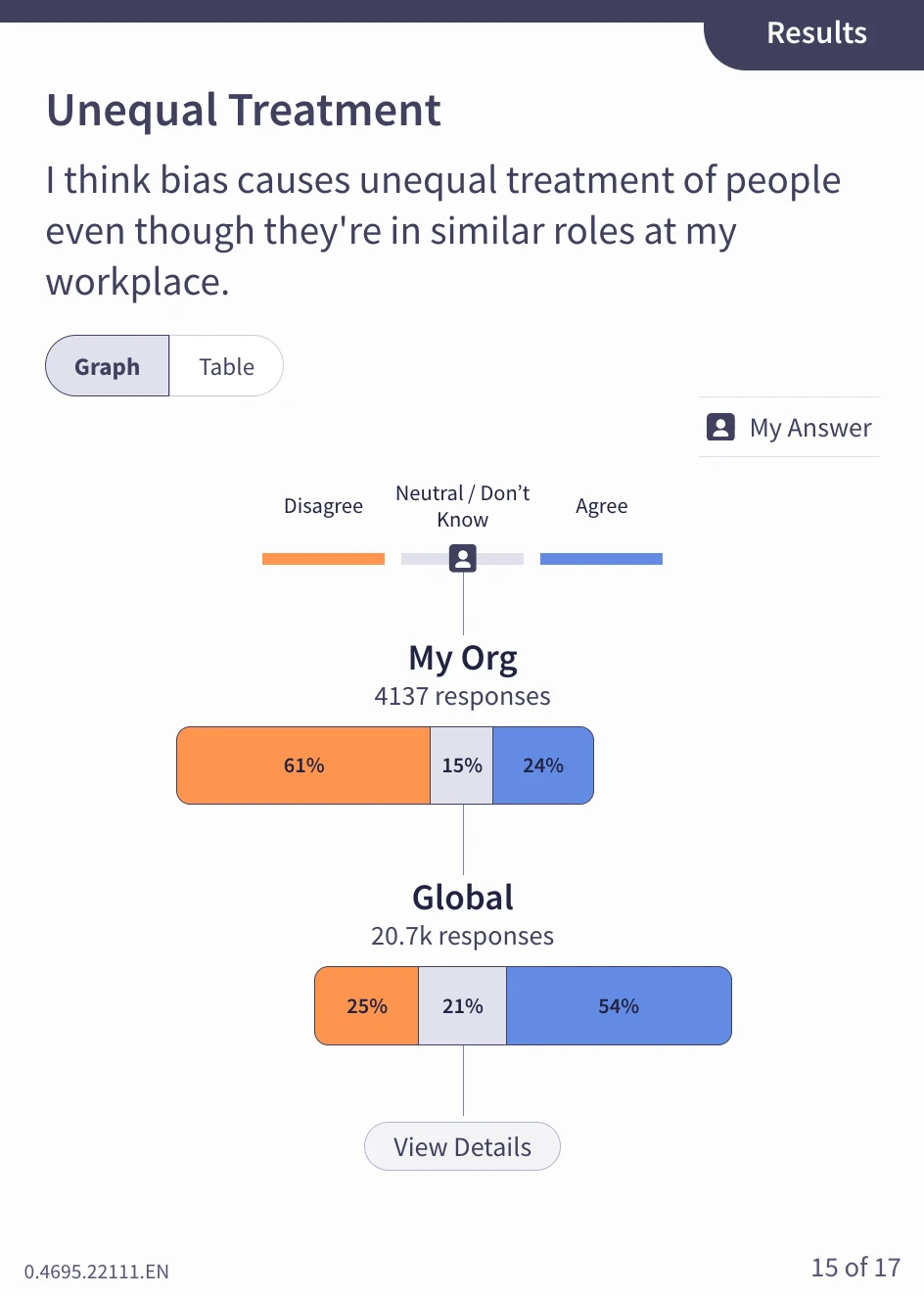
In Emtrain’s Recognizing Bias at Work microlesson, employees respond to the statement:
“I think bias causes unequal treatment of people even though they’re in similar roles at my workplace.”
Across more than 20,000 global responses represented in Emtrain’s survey data, 25% disagreed with that statement.
Why does that matter?
Because workplace bias can influence:
- Who gets hired or promoted
- Whose ideas are heard and valued
- Who is perceived as a leader
- How work and high-visibility assignments are distributed
- How performance is evaluated
- Who gets opportunities to advance
- Who eventually decides to leave
These are often interconnected decisions rather than one dramatic moment of bias. Emtrain’s Unconscious Bias Training specifically explores how unconscious bias can affect who gets support tasks, who gets heard in meetings, who gets recruited and hired, and who gets ahead.
What Are Other Common Types of Bias in the Workplace?
Race, gender and age are three common examples, but they’re far from the only ways bias can influence workplace interactions.
Bias can also involve disability, religion, pregnancy and other personal characteristics.
You may also hear terms describing the way our thinking becomes biased, including:
Affinity bias: Favoring people who have backgrounds, experiences or characteristics similar to our own.
Confirmation bias: Paying more attention to information that supports something we already believe.
Conformity bias: Allowing the opinions of a group to influence our own judgment.
Halo effect: Allowing one positive characteristic or accomplishment to disproportionately influence our overall opinion of someone.
Horns effect: Allowing one negative characteristic or experience to disproportionately shape our overall opinion.
Name bias: Making assumptions about someone’s identity or background based on their name.
These categories can help us understand how bias works. Similar categories are commonly used in workplace bias education; for example, Traliant identifies affinity, confirmation, conformity, halo/horns, gender, name, age and other biases in its materials.
But knowing their names isn’t the same thing as knowing how to respond when bias appears at work.
Knowing the Types of Bias Isn’t Enough
You could memorize every type of unconscious bias on this page.
You could correctly define affinity bias, confirmation bias and gender bias.
But tomorrow, when you’re sitting in a meeting, reviewing a candidate, assigning a project or evaluating someone’s performance:
Will you recognize bias while it’s actually happening?
That’s the skill employees need to develop.
This is why effective bias training needs to go beyond facts and definitions.
Employees need opportunities to see realistic workplace situations, examine their initial reactions and practice making more thoughtful decisions.
Emtrain’s approach combines real-world video scenarios, interactive employee surveys and expert insights so employees can see how different situations play out and learn practical actions they can apply at work.
The goal isn’t simply knowing what bias means.
It’s recognizing the moment when an assumption is about to become an action.
What Can Employees Do About Bias?
Having an automatic thought or assumption doesn’t mean you have to act on it.
The skill is learning to recognize when an assumption may be influencing your judgment and then creating enough space to question it.
When you notice potential bias:
- Recognize it. Notice the assumption and investigate where it might be coming from.
- Look for patterns. Pay attention to whether certain people or groups are consistently being treated differently.
- Talk about it. If you see a pattern affecting workplace decisions, raise the issue.
- Intervene. If someone is being negatively affected by biased behavior, don’t simply ignore it.
- Correct it. If you realize you’ve excluded someone or made a decision based on an assumption, take action to change the outcome.
Those are learnable behaviors. Emtrain’s Recognizing Bias at Work microlesson specifically focuses on recognizing patterns of bias, identifying biased behavior and taking an active role in changing problematic patterns.
Don’t Just Teach Employees About Bias. Teach Them to Recognize It.
Bias often happens quickly.
That’s exactly why reading a definition isn’t enough.
Employees need to practice recognizing the subtle moments when assumptions influence who gets heard, who gets opportunities, how coworkers are perceived and how decisions get made.
Emtrain’s Managing Bias Training helps employees understand how unconscious bias influences workplace decisions and provides practical strategies for recognizing mistaken assumptions and setting aside old patterns.
And Emtrain’s Recognizing Bias at Work microlesson uses realistic video scenarios to help employees spot patterns of biased behavior and learn how to intervene before those patterns become bigger workplace problems.
Think you can recognize bias when you see it?