
Home » Concepts » Discrimination & Harassment » RPWD (Rights of Persons with Disabilities Act )
The Rights of Persons with Disabilities (RPWD) Act, 2016 is a comprehensive Indian law that protects the rights of individuals with disabilities by promoting equality, non-discrimination, accessibility, and full participation in society—including the workplace. For employers in India, the RPWD Act establishes clear obligations to provide reasonable accommodations, ensure inclusive hiring practices, and create work environments where employees with disabilities can contribute meaningfully and without bias.
More than a compliance requirement, the RPWD Act reflects a modern shift in India’s workforce—recognizing disability as an essential part of diversity and inclusion, and requiring organizations to move beyond awareness toward actionable support and equitable opportunity.
Emtrain’s harassment training course is engaging, interactive, and designed to spot and reduce EEO risk.
India’s approach to disability rights has evolved significantly over the past few decades. Prior to the RPWD Act, the Persons with Disabilities Act of 1995 laid the groundwork for protections, but it was limited in scope. The 2016 RPWD Act expanded the definition of disability from 7 to 21 recognized conditions and aligned India more closely with the United Nations Convention on the Rights of Persons with Disabilities (CRPD), which India ratified.
According to the Government of India, Department of Empowerment of Persons with Disabilities, the RPWD Act emphasizes equal opportunity, accessibility standards, and non-discrimination across employment sectors.
Additionally, the International Labour Organization (ILO) highlights that inclusive employment policies in countries like India are critical for unlocking economic participation and reducing systemic inequality for persons with disabilities.
In the Indian workplace, this law is especially important given the scale and diversity of the workforce. Many individuals with disabilities remain underrepresented in formal employment due to stigma, lack of awareness, and insufficient infrastructure. Organizations that fail to comply with RPWD requirements not only risk legal exposure but also miss out on a significant and capable talent pool.
From an Emtrain perspective, inclusion under RPWD is not just about policy—it is about daily behavior, communication, and leadership decisions that either enable or limit employee success.
In practical terms, RPWD compliance shows up in everyday workplace interactions. The RPWD Act recognizes 21 categories of disabilities—ranging from physical and sensory impairments to neurological, intellectual, and blood disorders. This expanded definition reflects a more inclusive understanding of disability in India’s workforce, ensuring that both visible and non-visible conditions are protected under the law.
An employee working in a warehouse role may request ergonomic support due to a physical condition. A manager who understands RPWD will treat this as a standard accommodation process—coordinating with HR to ensure the employee has tools like a back strap or lifting weight limits. This allows the employee to maintain productivity while managing their health.
In another scenario, an employee with a non-visible disability, such as chronic pain or a neurological condition, may need flexibility in scheduling or workload adjustments. Without awareness, a manager might interpret this as inconsistency or lack of commitment. With the right training, the manager instead recognizes the need for support and adjusts expectations without compromising team goals.
Hiring scenarios are also critical in India’s growing workforce. A candidate with a disability may be overlooked due to assumptions about their ability to perform. Inclusive hiring practices—guided by RPWD—ensure that decisions are based on skills and qualifications rather than bias.
These examples reinforce that compliance is not limited to HR policies—it is embedded in how managers communicate, how teams collaborate, and how organizations design work itself.
Organizations in India that effectively implement RPWD principles move beyond reactive compliance and build systems of inclusion.
Clear accommodation processes are essential. Employees should know how to request support, and managers should be trained to respond promptly and appropriately. Delays or dismissive responses can quickly escalate into risk.
Equally important is building manager capability. Skills like active listening, empathy, and adaptability are critical when navigating disability-related conversations. Emtrain’s focus on communication-based training reinforces that inclusion is not just policy-driven—it is behavior-driven.
Workplace design also plays a major role. Accessibility should be built into physical spaces, digital tools, and workflows wherever possible. When accessibility is proactive, fewer employees are forced to advocate for basic needs.
Finally, organizations must address stigma. In many parts of India, disability is still misunderstood or under-discussed. Education and awareness programs help normalize these conversations and create a culture where employees feel safe disclosing and requesting support.
Emtrain supports organizations operating in India by bridging the gap between legal compliance and real-world application.
Through courses like Disability Protections – India, employees and managers gain a clear understanding of RPWD requirements, including what qualifies as a disability, how accommodations should be handled, and what constitutes discrimination under Indian law. These courses are grounded in realistic workplace scenarios, making the learning directly applicable.
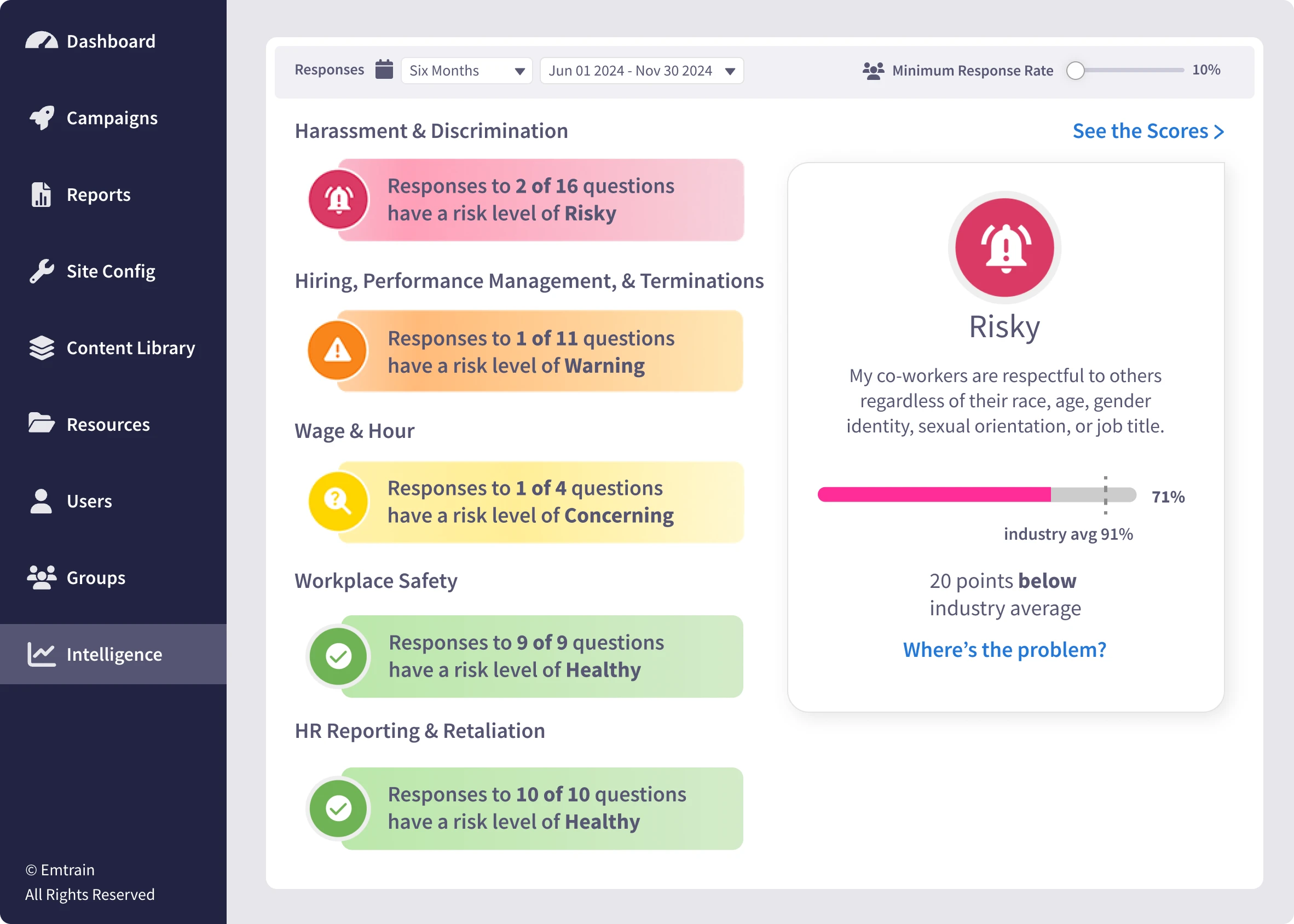
Emtrain Intelligence further strengthens this approach by monitoring risk areas such as hiring and performance management—two critical points where disability bias or missteps often occur. This allows organizations to identify patterns early and take proactive steps to improve.
Microlessons like Active Listening Skills and Adapting Feedback Styles reinforce day-to-day behaviors that support inclusion. For example, how a manager responds to an accommodation request or provides feedback to a neurodiverse employee can significantly impact both performance and psychological safety.
In addition, Emtrain’s broader content ecosystem—including resources like Enable All Abilities and Disability Inclusion in the Workplace—helps organizations continuously improve their approach to inclusion rather than treating it as a one-time initiative.
The RPWD Act, 2016 represents a significant step forward for workplace inclusion in India. But compliance alone is not enough. Organizations must translate legal requirements into everyday practices that empower employees and support diverse needs.
When done well, disability inclusion strengthens workplace culture, improves retention, and unlocks new perspectives that drive innovation. It also reduces risk—ensuring that organizations are not only compliant with the law but aligned with the expectations of a modern, inclusive workforce.
Ultimately, the goal is simple: create a workplace where every employee, regardless of ability, has the opportunity to contribute, grow, and succeed.
Summary:
A manager learns how to better support a neurodiverse employee by balancing team dynamics with individual workplace needs.
Situation:
In this scenario, a manager meets with an employee with autism who shares challenges with their work environment, including loud noises, bright lighting, and frequent interruptions that make it difficult to focus. The manager initially frames these behaviors as part of a collaborative and friendly team culture. However, as the conversation progresses, the manager begins to better understand the employee’s experience and the impact on their ability to perform.
Recognizing the need for a more individualized approach, the manager shifts toward problem-solving—working with the employee to identify practical adjustments that support focus and comfort while maintaining team cohesion. This moment highlights how awareness, active listening, and flexibility can transform a potential point of friction into an opportunity for inclusion and improved performance.